Thursday, March 11, 2010

Web 2.0 Exploration


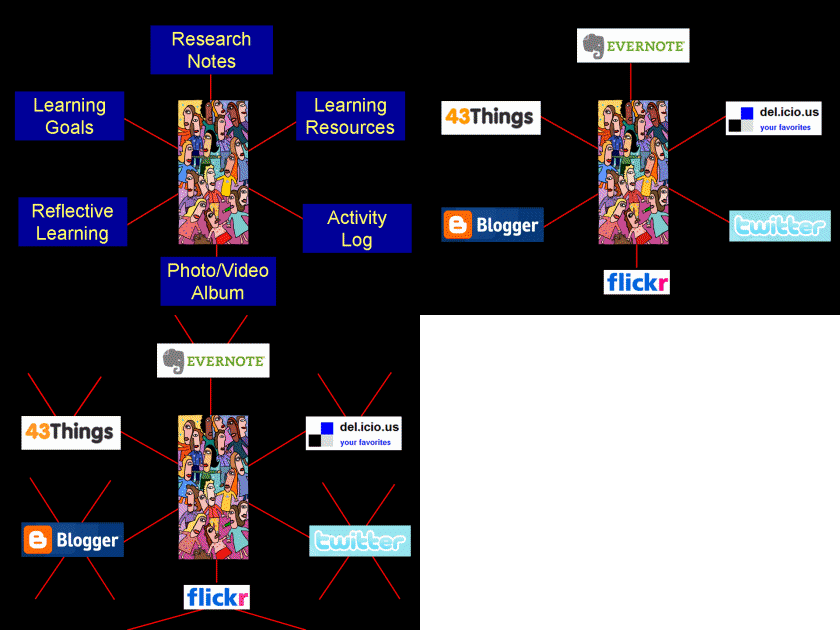
40% of Polytechnic teachers are currently exploring web 2.0 or collaborative web services for learning. Many are using online blogs, photo or video albums for reflective learning or folios for assessment evidence or showcasing work.

The graphic above shows some examples of other web 2.0 services being used by teachers for learning, teaching and assessment. The red lines are indicative of the networks of 'friends' that each service may also bring to the 'classroom' giving an outside audience and increasing the potential for collaboration.

The Flexible Learning Team is now making some recommendations about which particular web service to use for specific learning tasks or desired learning outcomes. This will not only guide those who may be looking for a service to meet their needs but also create a critical mass of users within the organisation that can help each other.

Wednesday, February 24, 2010

Game on for Learning

Panorama of AppV Games on CleVR.com


Today 60 students were playing networked games as part of the Enrichment Program on the Elizabeth Campus thanks to dedicated problem solvers in ICT Services. Simon and Rob (pictured far left and centre - they were moving fast...) used MS Application Virtualisation (App-V) to deploy 60 instances of legal games across normal student networked computers.

The beauty of this is that the games don't affect the other software running on the network or network performance. While playing the games students have no access to the internet and play time can be controlled centrally.

The test run today proved it worked brilliantly! Game-based learning environments have been used on various campuses before for

  • developing literacy, numeracy and communication skills
  • digital story telling
  • machinima (movies made 'in-world')
  • modding (building games using commercial game engines)
  • character design, AI and scripting
  • 3D design and terraforming
  • problem solving and system thinking skills

Today's session was just about fun and the doors had to be closed after the first 60 students arrived leaving many disappointed!

Simon and Rob's work will mean that ICT Shared Services can provide similar engaging learning environments across all campuses into the future.

Thursday, February 11, 2010

Enabling a Learning Commons

Click graphic for full size


Polytechnic Libraries and Learning Centres have been evolving for many years and now bear little resemblance to the traditional libraries that many might remember from twenty years ago.
This evolution is continuing as we plan to meet the needs of tomorrow's learners, teachers and other clients. The Polytechnic Corporate Plan (2009-2010) outlines a 'learning commons' philosophy that further integrates learning and support services for students and facilitates the flexible-applied-connected-supported learning agenda.

In addition the State Library and UTas Library are changing to meet client needs. The national Re-Imagining Libraries Strategic Plan is indicative of the directions many libraries are taking:

"In collaboration, the National, State and Territory Libraries of Australia and New Zealand will become leaders in empowering people to create, discover, use and transform our collections, content and global information resources."

These directions require more open and connected ICT services than has previously. The Polytechnic Library Online Services Project team has been mapping the ICT functionality needed to meet the above agenda.

The above graphic (click for full size) maps the ICT functionality to enable:

  • Information and resources to come into the organisation including Open Education Resources, Open Courseware, RSS feeds... (LHS of graphic)
  • Information and resources produced or added to by students and staff within the organisation including Open Education Resources, Open Courseware and RSS feeds to be shared with others (RHS of graphic)
  • Online access by students and staff within the Polytechnic via normal logon (LDAP) or Open ID (bottom of graphic)
  • External access by school students, mentors, local communities... via open unauthenticated access or Open ID (top of graphic)

These needs will now determine the kinds of systems that will be required. Current ICT systems may or may not be sufficient.

Sunday, February 7, 2010

E-Portfolios for students and staff

E-Portfolios are now ready for anyone in the Polytechnic who wants to use them - staff, classes, groups, individual students... As described before we are using Mahara to provide this service. We have two hosted services arising from different pilot projects in 2009 - one is just Mahara and the other is an integrated Mahara + Moodle installation.

Teacher and user guides (video and text) are available and a community of practice has been established across all campuses. It will be interesting to see how many staff and students decide to use E-Portfolios who were not part of previous projects.

Problems encountered during the 2009 projects will hopefully be addressed with recent changes such as


  • upgrading Internet Explorer 6 to Internet Explorer 8
  • upgrading Mahara to allow for importing and exporting
  • customised help
Mahara isn't the only solution for E-Portfolios. Some staff and students choose to use

A survey of staff at the end of 2009 revealed that 40% were exploring so-called web 2.0 or social media sites for use with students. The attraction of Mahara is that it provides some social media functionality within a local learning environment while still providing student control of access to work including external access via a 'secret' URL.

Students can connect with and share work with classmates or friends as well as teachers and feedback from students in the 2009 projects indicated that this was highly valued.

Tuesday, June 2, 2009

Re-framing the Present

The current restructuring of Tasmanian public post year 10 education provides a good opportunity to re-conceptualise ICT services to match learning needs. A new ICT network infrastructure has been built from the ground up that supports both legacy and new systems across 16 campuses statewide.

Learning priorities have already been re-framed as the FACS Learning Model - Flexible, Applied, Connected and Supported Learning. In what ways can we re-conceptualise ICT services to enable, facilitate and support the FACS Learning Model?

We have already attempted to map a student perspective on current and planned ICT services, and to map the notion of a Virtual Campus. This post attempts yet another map - starting with learning. The learning priorities on the left are linked to the necessary ICT functionality to support them on the right:


Does it show the important ICT functionality required to enable, facilitate and support FACS Learning?

The next part of this mapping exercise emphasises the need for management processes and tools for the learner, the teacher and the institution .

'Manage MyLearning' is about each learner's need to manage all the processes, artifacts, resources, networks... as they continue their learning journey - particularly as the learner becomes more self-directed.

The teacher needs to manage their teaching processes, resources, classes, students, professional networks... Recently some have done this in a Learning Management System (LMS) - which has really been more of Teaching Management System for most.

'Manage MyInstitution' could be seen as the institutions need to manage facilities, services, staff and students... (Or it might be taking the 'My' trend too far...)

Are there other key roles that should be included here that will inform the provision of ICT services?


The next map shows some of the ICT services that might support learners, teachers and the institution. A brief description of each follows...


Folio & Pathway Management Systems: This is about much more than the provision of efolios. It is about each learner managing their own learning choices, resources, artifacts, networks... on their learning journey (pathway). The learner has control over who can view, access and share their learning resources and artifacts.

Learning Management Systems: This is the standard LMS functionality which is mostly about teacher structures and controls to support learning, teaching and assessment.

Information Management Systems: This is largely about managing and communicating institutional information and resources. Systems such as MOSS have evolved to integrate greater functionality however this requires authenticated access to a closed system.

Learning Environments: These include spaces and structures such as virtual worlds, simulations, serious games, augmented reality... Some of these can integrate resources and functionality from other management systems - eg Sloodle.

Virtual Learning Commons: This is the online component of the 'Learning Commons' that includes additional services to learning resource access such as learning support, client services and exhibition spaces.

Shared Services Management Systems: Finance, Facilities, Human Resources and much more.

Learning and Business Applications & Web Services: Office, specialist and learning tool software and web services. Includes application deployment.

Research & Project Management Systems: This has been somewhat ad-hoc in the past and could evolve to support collaborative innovation and research within and beyond the institution.

Course Management Systems: This could evolve beyond the management of in-house courses to the provision of access to Open Courseware.

What other key ICT services are required to support FACS learning?

Still missing from this mapping exercise are the range of services - including some of the management services above - that exist beyond the institution.


The full map can be seen here.

.
Monday, May 25, 2009

eFolios for Learning and Life

This year we are "establishing and implementing a Polytechnic ePortfolio strategy" across all campuses. A significant part of this work will be informed by a 2009 E-Learning Innovations Project 'E-portfolios are 'living' evidence' supported by the Australian Flexible learning Framework.

This project focuses on using efolios (Mahara) as an integral part of the learning process - a process described in the 2008 JISC report as 'e-portfolio-based learning'. Last week saw the first orientation session into Mahara for the group involved in this project.

Graeme and I presented some background information on folios and learning processes and we spent some time playing with Mahara - uploading artifacts, setting profiles, linking with 'friends' and creating views.

Unfortunately the laptop links through a hub failed only worked for a couple of people so we had to resort to external broadband wireless connections through mobiles phones and pre-paid USB modems. Fortunately we were able to get a surprising number working.
I've decided I love my ultra-notebook and pre-paid broadband. No more worries about being able to connect at different locations and no more firewall hassles - I use Telstra services... I can load all my own applications - and they work as expected.

At 1kg the ultra is great to carry around - my laptop is 3.5kg and more when it's in its bag.

I've notice a few other staff going down this path as well - and some students. But I digress...

Here are some of the slides we presented during the day:


Uploaded on authorSTREAM by regor2012

The efolio project is part of a bigger picture of the range of ICT services used by learners - how and where and when they access them - and who provides them. The 'bigger picture' for the new Tasmanian Polytechnic is about flexible, connected, applied and supported learning which can be enabled and/or enriched through
  • efolios
  • portals
  • LMSs
  • virtual worlds
  • augmented reality
  • serious games
  • communication and collaboration environments
  • media channels
  • galleries
  • open courses
  • learning commons
More on these later...


Last Thursday I attended an RMIT 'roundtable' on efolios and RPL. It was very useful - partly because we heard that we have been doing what everyone else is doing and partly because I made links with several institutions that are using Mahara. I also got to meet Alison Miller after following her for a couple of years on Twitter and journals. She provides a great channel to what is going on in the efolio world - and other things.

Towards the end we started to talk about the broader use of efolios for learning and life. This is definitely a conversation to continue in the near future.

Sunday, May 24, 2009

Measuring Flexible Learning - Breadth and Depth

We are thinking about how to establish benchmarks and measure progress in flexible learning across the Tas Polytechnic - 16 campuses and 1500 teaching staff. But before we can decide on some key performance indicators we need a common and agreed definition of flexible learning.

Flexible learning is often defined as providing learners with choices about where, when, how - and sometimes what - learning occurs. The goal is personalised learning that meets the needs of each and every student - both on and off campus.

The degree of flexible learning that an educational organisation can provide will depend on a range of factors including:

  • learning, teaching and assessment principles and practice
  • facilities and support structures
  • course and learning designs
  • learner engagement and responsibility
  • accountability and quality assurance

Strategies which have been used to increase the level of flexibility in learning include:

  • eLearning and Flexible Delivery
  • Flexible/Open Learning Options
  • Curriculum/Training Package Frameworks
  • Learning Environment/Space Design
  • Professional Learning, Sharing and Collaboration
  • Facilities and Infrastructure for Access and Equity
One objective of the Tasmanian Polytechnic is to "establish flexible learning as part of every teacher's repertoire" - broadening the availability of flexible learning options beyond 'champions', early adopters and specialist areas and deepening the degree of flexible learning beyond the provision of simple content and delivery alternatives.

Flexible learning is not new to the organisation. Many - if not most - teachers already provide some form of choice for learners and there are numerous examples of individuals, teams and learning areas that provide very effective and innovative options for personalised learning, learning spaces and learner support. We need to learn from these and 'mainstream' them.

There are many examples of flexible 'elearning' including some that not only offer content, delivery and communication choices but go deeper to collaboration, reflective assessment and blended learning.

The Australian Flexible Learning Framework suggests a range of elearning indicators that we could adapt for measuring flexible learning. A number of these could use data that is already being collected to establish some early benchmarking.

Does anyone know of any other measures or KPI lists for flexible learning in that go beyond superficial adoption of ICTs?
.