Showing posts with label collaboration. Show all posts

Friday, August 9, 2019

Epic Climate Change


The world is in a period of ‘great transition’ - UN Secretary-General Ban Ki-moon (2012)

‘The Great Turning’ of humanity is about crisis and possibility. It calls for an awakening consciousness. Joanna Macy (2010)

We’re in a race between consciousness and catastrophe as we move through an ‘evolutionary transformation’. Terry Patten (2018)


Climate change is part of a bigger picture – a much bigger picture.

It’s a bigger picture of transformational change of epic proportions rarely experienced by humanity. And it’s happening now!

Some say that the earth and humanity is ‘levelling up’ – and feel called to embark on epic/mythic and sometimes dangerous journeys to do what they can.

They may choose to play the role of hero or heroine – and there have been many great examples over the last 50 years of climate change. But we can’t be saved from climate change by the lone archetypal hero/heroine on journeys to overcome the ‘dragon’. The hero archetype in particular - which still dominates mass media – takes people on old masculine journeys of aggression, persistent conflict, linear thinking and violence.

The hero/heroine may be necessary to raise awareness but it isn't sufficient to instigate whole systems change.

Some have written about the new gendered journey which is a more inclusive evolved archetype. The gendered journey is emotional rather than cerebral - it’s a journey of transformation.

But this too has fallen short when dealing with the complex relationship between climate change, the biosphere, sociocultural systems and social justice issues.

Maya Zuckerman says it’s time for a collective journey where groups of people rise to a call and “move beyond their own individual experiences to a cohesive collective that is both the sum of all individuals and also a new entity entirely.”

Some believe the #MeToo movement and the Arab Spring are examples of the new 'collective journey'.

Zuckerman sees the collective journey as a nonlinear, multidimensional, physical and digital experience of diverse people, groups, tribes, cultures, and networks coming together for a higher purpose and a common cause.

Some see Game of Thrones as an example of a collective journey archetype. The hero can die instead of saving the day.

Perhaps climate change and its deeply connected social justice issues need all of the above – hero/heroine journeys, gendered journeys and collective journeys – and more.

Some feel called to adopt new (or ancient) roles of the champion, the steward, the sage, the shaman, the magician, the lover, the wise gardener, the trickster, the peaceful warrior, the elder… These bring to awareness different ways of being, new intuitions, new wisdom, new opportunities, new dreams and visions of the future.

Climate change is a wake-up call. The epic nature of our interconnected global challenges invites an epic response – individually and collectively.

And this response is not all doom and gloom. Terry Patten reminds us that responding to a deeper calling can bring us into flow with inspiration, wonder and joy.

We need to adopt new roles and explore new narratives with evolved archetypes that tell the story of “the more beautiful world our hearts know is possible”.

Image: darksouls1 Licence: CC0

Thursday, August 1, 2019

A Climate of Emergence

A Personal Response to the ‘Climate Emergency’


My city council has joined many cities, councils, universities, doctors, hospitals and business around the world in declaring a ‘Climate Emergency’.

While many people now accept that climate change is an important issue few feel able to do much about it. I believe everyone can contribute in their own way - and many are.

Terry Patten believes many live within a ‘Consensual Trance’ that tacitly accepts ‘official’ narratives (however unfounded they may be) and encourages us to repress, deny or reject inconvenient truths.

This consensual trance has its roots in the beliefs, assumptions and worldviews that are several hundred years old. These eventually generated the interconnected complex systems of western culture that many now recognise no longer serve humanity and are degrading the planet.

Complex systems are hard to shift - partly because they require ‘systems thinking’ to understand them and partly because they are underpinned by personal and cultural beliefs and assumptions that are generally unquestioned.
The Buddhist notion of a ‘Hungry Ghost’ captures another issue that drives existing social systems and cultures - and contributes to an early World Overshoot Day.

People behaving as a hungry ghost have an insatiable desire driven by the need for deep meaning and purpose in life. They attempt to fill this inner void by consuming things and experiences that give short term comfort but that can never satisfy the soul. There are many hungry ghosts on earth today.

Deep seated fears also play a role.  Aspects of contemporary western society reflect the personal and collective fears of lack or attack borne of a strongly held belief in the separation of self from others and nature - within a purposeless universe. This drives competition, exploitation of resources, fear of the other and annual global military spending of US$4.9 (AU$7.2) billion dollars a day.

Our beliefs and assumptions are embedded in our stories - stories that need to be changed if we are to successfully address the ‘climate emergency’ and related global challenges.

Fortunately there are new stories based on discoveries made over the last century that speak of the fundamental interconnectedness and consciousness of everything.  The universe and life are interpenetrating wholes. These new stories are only just beginning to impact contemporary culture.

The new stories reinforce some indigenous knowledge and practice as well as humanity’s ancient wisdom traditions. Duane Elgin believes that "a great transition story can awaken our collective imagination and orient our actions. With a common story, we can see our place and our part; our lives become more meaningful; change is less overwhelming and stressful; and we can see how to cooperate more readily."

One of the new stories is that the evolution of life includes the evolution of consciousness. In some versions of this story humanity and the earth are currently evolving much faster than in the past. Humanity is now conscious of this evolution and can begin to influence its direction through conscious evolution.

Joanna Macy describes ‘The Great Turning’ as the transformation of society, including people’s relationship with one another and with Earth, and links this to an emerging story of expanded awareness, ecological sustainability and social justice. Some estimate there are approximately 2 million organisations now working within this new story to change collective consciousness.

Annick De Witt highlights the "critically important phenomenon of worldviews in the urgently needed transformation to sustainable societies.” Traditionalist, modernist and postmodernist worldviews (or frames) each have valid though only partial perspectives of our world.


Charles Eisenstein believes today’s obsolete though still widely held 19th and 20th century beliefs and assumptions limit our view of what is real, possible and practical thus limiting our options to address climate change and related global challenges.

Addressing climate change requires the emergence of new ways of thinking and being. Albert Einstein noted that we can’t fix problems from the consciousness that created them.

New ways of thinking have emerged from interdisciplinary and transdisciplinary approaches that take us beyond discipline boundaries. Integral and holistic worldviews are including and transcending the perspectives of previous worldviews. Wicked problems, social foresight and futures studies provide new tools to assist in the co-creation of emergent preferred futures.

These new ways of thinking emphasise inclusive discourse, collaboration, co-creation and transformation. Every generation, culture, group, people, nation, gender, discipline... has a necessary and vital voice.

Several big picture stories have emerged with close parallels to cosmologies in both indigenous cultures and ancient wisdom traditions. Big History, The Universe Story, Great Transition StoriesThe Story of Interbeing, Living the New Story, Cosmic Evolution and Evolutionary Consciousness are some examples.

Spirituality (not religion) is a common theme through many of these new stories. They are driving the current global ‘Spirituality Revolution’ which feeds the soul of the hungry ghost providing a coherent sense of meaning and purpose. People are increasingly experiencing a personal spirituality through a sense of the sacred, peace, connection, awe, love or presence in nature and through indigenous practices.

The emergence of a new contemporary spirituality can be seen in Spiritual Ecology, Sacred Economics, Holistic Education, Transpersonal Psychology, Integral Theory, Spiritual Intelligence, Spiritual Activism, Indigenous Wisdom, Global Consciousness Project, Mindfulness, Politics of Love, Pedagogy of Universal Love, Economics of Happiness, Conscious Evolution, Sacred Earth, Fourth Bottom Line, Conscious Capitalism, Conscious Business, and many more.

Spirituality is about unity and wholeness, intuitive wisdom and inner guidance, sacred places and unbroken connections, mindfulness, conscious evolution and awakening, deep peace and joy, presence and purpose, compassion, unconditional love, and much more.

A spiritual perspective on the climate emergency can lead to the emergence of new insights and new possibilities for individual and collective knowing, being and action. Spiritual awareness can provide access to a range of powerful spiritual tools and practices.

Spiritual intelligence recognises the multidimensional nature of life and the universe. It understands there is no separation and little to fear but fear itself. Spiritual intelligence/awareness/insight is more effectively accessed when the mind and emotions are calm and the body is peaceful.

Spiritual practice is unique to each individual. It may be a mindful walk in nature, meditation, positive affirmations, compassionate service to others, physical movement and breathing, active listening, or peaceful quiet time.

A spiritual response to the climate emergency respects a sacred and evolving earth. Any inner work to love self and others complements and strengthens our outer actions.

A spiritual perspective inspires and empowers individuals to express their unique gifts for the benefit of all. Some who hold a spiritual worldview may feel a deep and specific ‘call to action’ while others quietly impact on those they meet on their life journey through their gifts, presence and love.

Contemporary spirituality greatly increases the ways in which every person can help to transform society and meet global challenges with optimism, creativity and joy. It's grounded in the co-creation of preferred futures within our local communities, driven by love and compassion, and empowered through our fundamental multidimensional wholeness and connection.

A spiritual view of the climate emergency sees the opportunity for the evolution of humanity resulting in the emergence of a new awakened consciousness that co-creates the "more beautiful world that our hearts know is possible."

Some say that the planet doesn’t need saving - it needs loving. That's something we can all do.


'Saving humanity' may be more about giving and receiving invitations to awaken into an expanded consciousness through love. It may be more about compassionate respectful listening to people with different worldviews than pointing the finger and identifying 'the cause'.

Breath first, heart next, mind last.

Thursday, September 29, 2016

ePortfolios Australia 2016 Forum - Day One Reflections

I'm attending an eportfolio event for the first time in 5 years.

Five years ago I was working on eportfolios for learning and assessment with TAFE students and teachers using Moodle/Mahara.

Today part of my focus is on the safe and effective use of social technologies within a new Tasmanian government My Education program.

Within this program the eportfolio agenda has shifted to
  • support career assessment, guidance and planning (My Education and Kuder Navigator for years 7-12)
  • provide an external link for potential employers and further education (Kuder Navigator)
  • support students to safely create a professional, responsible and respectful online presence through their chosen social technologies (plus LinkedIn for students in years 9-12)
  • support student learning and parent engagement
  • provide ongoing access to the above ePortfolio (Kuder Journey available to school leavers and the general community through libraries)
In this context my takeaways from the sessions I attended on the first day of the 2016 ePortfolio Forum (principally for higher education) are:
  • ePortfolios appear to have found some implementation niches - work-integrated learning, student centred/directed learning, continuing professional development, authentic/transdisciplinary learning, wicked problems...
  • Employers are looking for deeper insights into and points of difference between applicants - the focus is more on soft skills, creativity, marketing... An eportfolio (and social media) provide a window to these.
  • Learning artifacts and reflections are now more easily captured at the point of learning via mobile devices.
  • More ePortfolios reference employability/capability/CPD skills providing meaningful frameworks for students and employers.
  • ePortfolio-based tasks count for formal assessment.
  • Students are using social media for learning, uploading, sharing and peer review/critique.
  • Students are choosing cloud services and apps for learning and productivity tools.
My keyword to describe eportfolio use and implementation is now 'wicked' :-)

Saturday, February 27, 2016

Next Gen Government - Day 2 Takeaways

A small edit to the Waterforms International Water Vortex while waiting for departure at Canberra Airport. Somehow it feels appropriate for this post... See quote at the end.
These are some random thoughts I'm taking away from the second day of sessions at #NexGenGov in Canberra. These mostly relate to our current Department issues/projects rather than a comprehensive report on what was said - or who said it.

Innovate on service delivery not technology. 

Focus on customer events, circumstances, their journey...
Identify services with the highest impact. 

For many external clients (and even staff) your website 'landing page' is the Google search results page. 

The Department has Google+ pages for all schools and this has been very effective.
How might we influence/customise Google search results for the Department's main public online web and other online spaces? How could we use Google Ads and APIs?

Does current navigation make sense to the user when they drop deep within our website/CMS from an external search engine?
Need for a rethink...

The 'Internet of Your Things' offer opportunities to rethink aspects of service delivery.

Young people (including young adults) do not generally go to a government website for help.

How do we reach out to this group? Go to the platforms and places used by your intended audience.
Social media? Which platforms are being used by your intended audience? What value can you bring?

Gamification? Mobile Apps?  See Party for Your Rights.

The notion of a 'one stop shop' may become the 'one stop pop-up shop'.

Proactive Organisation - provides a product or service when it is needed rather then after it has been requested... 

Innovation SPRINT - 10 days - Discover, Define, Develop Ideas, Deliver Alpha.
Trans-departmental teams, design thinking, blue-sky thinking by 'digital natives'.
Leave space in thinking, processes and solutions/products for innovation.

Drive rapid iteration.

Overcome the fear of failure - "fail fast, fail cheaply".

3 steps to making 'good mistakes'
1. making mistakes after due care and attention
2. acknowledging mistakes
3. not repeating mistakes

Common current drivers are fear and hope - fear of disruption/disconnection/disengagement - hope for transformation.

Launch Alpha to selected audiences - even public- and then move to 'perpetual beta' or launch Beta and then move to ongoing interative development.

Gartner predicts 75% of digital organisations will 'build' not 'buy' by 2020.

See the US Digital Services Playbook - "Today, too many of our digital services projects do not work well, are delivered late, or are over budget. To increase the success rate of these projects, the U.S. Government needs a new approach. We created a playbook of 13 key “plays”...  "

Social Media

Think about archiving social media - have information management policy/procedures for social media. Think about minimum meta tags for social media.


See national Digital Continuity 2020 Policy and actions/dates.

Open Source, Open Data, Open Culture, Open Government

Open source is about much more than software. 
Tasmania has a new Open Data Policy

In what ways are we benefitting from and contributing to the staten national and globalopen agenda?
During 2016 the Department will be seeping its adoption of Creative Commons Licensing. How might this facilitate a more open culture and enable changes in service delivery?

AI, natural language and the user interface

How far away is a Siri/Cortana user interface for organisations?
"What can I help you with?"

Digital Identity and Authentication

Biometrics is delivering higher confidence authentication

One identity and login for multiple government services...

Watch MyGov, MyTax, My Health Record over the next few months and years...

Google ID, Apple ID, Facebook Connect... are already international IDs and logins.

Blocks to innovation and faster development.

A focus on fully tested perfect solutions delivered years into the future.

A focus on how to monetise assets rather than what we can do that's best for citizens/clients.

Being risk averse about privacy and security issues rather than using 'Privacy by Design' principles, getting it right, and then moving on. 

"Silicon Valley is a state of mind not a place."

Jack Welch

“If the rate of change on the outside exceeds the rate of change on the inside, the end is near.” ― Jack Welch


Wednesday, February 24, 2016

NextGen Government 2016 – My Day 1 Highlights


I’m attending the NextGen Government 2016 sessions at a time when our state Education Department is taking a step back and reviewing online services before moving forward.

This review is shaping up to be a little different from those in the past for a number of reasons:
  1. There is general acceptance that a review is necessary
  2. There is an enthusiasm for participating in the review
  3. There is some appetite to do things differently
  4. The review is a collaborative project involving IT services, marketing, communications and digital media, and an external consultant.
Within this local context my takeaways from day 1 of #nexgengov were as follows.
  • User expectations have changed – largely driven by the commercial sector.
  • Users want online services to be simple, accessible on mobiles and satisfying.
  • Use client language  - not the language of compliance.
  • 55% of users can’t find what they are looking for.
  • Users want search to work, easy navigation and click-to-chat.
  • Most users enter websites deeply via Google – not via your front page.

  • Technology disruption is now largely seen as a positive thing – this is a big change and an opportunity to create the future.
  • Move focus from procurement to servicing user needs. User-centred design.
  • Spend twice as long talking to users as other activities when preparing business case.
  • Start by telling the user story – then expand the story and join the dots. Explain the level of pain.
  • What is it really like as a user? Follow the human experience. Get on the ground and see how things work.

  • Agile. Agile. Agile. Smaller projects with rapid iterative development. Larger projects should not take such a long time to get to launch – if they do you are too late because things have moved on.
  • Public access and testing of Alpha, ongoing Beta iterative update.
  • Iterative design and iterative development is an explosive combination.
  • Culture. Culture. Culture. Culture eats strategy for breakfast. Eliminate blame culture.
  • Service to others is a key driver for staff.
  • Keep good people by doing interesting work, creating things that make a practical difference.
  • Collaborate. Collaborate. Collaborate. Collaboration is about giving up something to make someone else successful. Consider In-sourcing AND Out-sourcing.
  • Talk about values, needs, courage to take risks.
  • Openness, honesty, transparency generates trust and respect.

  • Benchmark what happens now.
  • Think through intended and unintended consequences.
  • Create once publish everywhere.
  • Citizen design – get users involved in design.
  • Gov 3.0 – customisable services
  • AI and data layers
  • If your data isn’t being openly shared you are missing out on opportunities - and soon the future of online services
  • Innovate. Innovate. Innovate.

While much of this isn't new to our organisation I'm not sure it's deeply understood.

Much of what was discussed today fits within a simple 4 quadrant model from Integral Theory from a few yeas ago. The key message is that the left hand side cannot be ignored.

Image: Dr Sue Stack


Looking forward to day 2...

Sunday, August 30, 2015

Where to from here? A wicked problem

A great deal has changed in the ICT space for our schools over the last two years - the rise of social and mobile media, the use of cloud services for the effective and efficient delivery of agile infrastructure, and the interest and influence of large national and multinational companies - to name a few.

At the same time there's been a more gradual but just as profound change in society and culture as a result of the pervasive and often invisible ICTs. The trends and expectations I see in my role can be summarised as follows.


New approaches are required. This challenge has the characteristics of a ‘wicked problem’.

It is a moving target and is socially complex. It involves changing values and new behaviours.

It challenges current boundaries and policies, questions assumptions, and there may be no single ‘solution’.

 
To understand wicked problems I like the analogy of playing a ball game.

You are focussed on the ball and reaching the goals...
You build personal and team skills and become strategic.

Then the goals move - but you are not distracted and remain focussed on the ball...

You sense the ground shaking under your feet - but you skilfully adapt and approach the goals.

You kick a brilliant goal and raise your arms! But all is quiet...

As you look around you notice that half the players have gone...
The stadiums are largely empty.

The crowd are watching a new game being played on a different field some distance away.


The use and support of digital media for education is a wicked problem.

Photo: Creative Commons - Wikimedia

Saturday, August 7, 2010

Building a Sustainable Polyverse

How do we build, maintain and innovatively grow a virtual campus that learners, teachers and the community will find easy to navigate, useful and inspiring?

Previous models of ICT provision have focused on a shared services model that provides a walled garden within which learners, teachers and administrators can enjoy reliable, secure and controlled access to computers.


Over the last decade however 'classrooms without walls' have become 'institutions without walls' as learners and teachers became more comfortable using external web services, mobile devices and 3G wireless access on and off campus. Open source solutions hosted on external servers began to appear and have been used by some learning teams (FL & WFS) to provide learning environments and/or services not available from shared ICT services.

More recently learners and staff have increasingly turned to campus libraries (learning centres) for ICT assistance which has become more complex with learners using a larger and more diverse fleet of campus desktops/laptops/netbooks as well as their own mobile devices. In addition learners are utilising a range of external web services and are accessing learning resources almost 24/7.

So... how do we sustainably build and support a coherent virtual campus described in the previous post? Available human resources include
  • Shared ICT Services staff
  • Teaching and support staff
  • Students - as IT trainees, as learners, as content producers
  • External web and hosting services - helpdesks, forums, service contracts

Students are a largely untapped resource. IT students can provide substantial IT helpdesk services in many forms - physical helpdesk, online assistance and library support. Other students are skilled in using specialist applications or services within their course and can offer additional ICT services through a community of practice and/or project-based models. For example creative arts students can produce components required for a virtual world or graphics for an LMS.

In addition students participating collaboratively in different regions of the 'Polyverse' produce digital content that meaningfully adds to available learning and teaching resources.


In order for this new structure to work as an effective, reliable and sustainable whole, new guidelines will be required. Ideally the whole 'Polyverse' would be more than the sum of its parts - a coherent virtual campus with new affordances emerging to support new ways of learning, working and being together.
Whether a student is on a large city campus or isolated in a remote location they should be able to seamlessly access learning resources, equally participate in some aspects of campus life, and hopefully experience a sense of belonging that has been shown to be so important for continued engagement.
Time now to think about the guidelines needed to build and maintain a sustainable 'Polyverse'...

Saturday, April 24, 2010

Playing TAG

Many staff and students are using web services for displaying, organising and sharing their work. A number of Creative Arts teachers have been looking at how work might be tagged within these services so that staff and students can search for products created

  • by Tasmanian Polytechnic students and staff
  • in the same course or qualification
  • on the same campus
  • using the same media

In addition to facilitating searching a state-wide tagging system could allow teachers to easily collate student work for quality assurance/moderation across the state.

One issue to be addressed is the fact that students and staff are currently using a range of different web services for the same function. For example photos are uploaded into Flickr, Picasa, Deviant Art... We can create a single RSS feed from multiple web services by using an RSS aggregator that creates a new combined RSS feed such as Yahoo Pipes - rather than mandate a single web service.


We would also like to showcase student work by tagging items so that they automatically appear in RSS feeds within embedded code set up for our intranet, Facebook and public website. This will be archived by creating a Flickr group (linked to a state-wide Creative Arts Flickr account) where students can display their best work. Some of this work will then be tagged for showcasing - as well as being organised into sets and galleries.

This cross-campus tagging can also be applied to web services for video, audio and other media - any services that provide an RSS feed from tag searches.

Some of the thinking behind the use of tagging is presented in the following slides created for Creative Arts staff considering using Flickr for the first time to encourage student comment and reflection. They would also like to use it to facilitate some mentoring and critique from the arts community outside the organisation.


Thursday, March 11, 2010

Web 2.0 Exploration


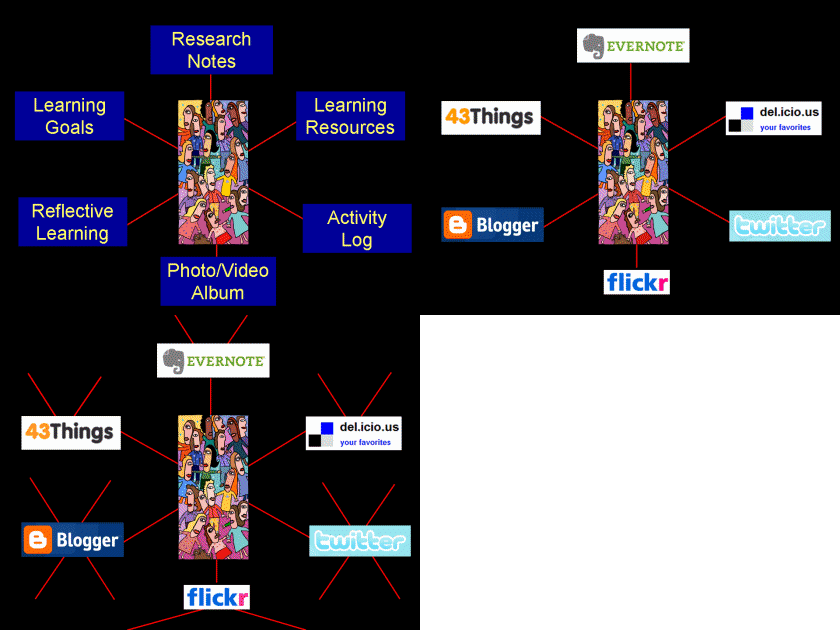
40% of Polytechnic teachers are currently exploring web 2.0 or collaborative web services for learning. Many are using online blogs, photo or video albums for reflective learning or folios for assessment evidence or showcasing work.

The graphic above shows some examples of other web 2.0 services being used by teachers for learning, teaching and assessment. The red lines are indicative of the networks of 'friends' that each service may also bring to the 'classroom' giving an outside audience and increasing the potential for collaboration.

The Flexible Learning Team is now making some recommendations about which particular web service to use for specific learning tasks or desired learning outcomes. This will not only guide those who may be looking for a service to meet their needs but also create a critical mass of users within the organisation that can help each other.

Saturday, April 18, 2009

Collaboration in Learning and Teaching

Listening to a recent Stephen Downes presentation and reading a recent education.au report has progressed my thinking around collaboration, personal learning networks, virtual learning commons and efolios - and led me to try something new.

The 2009 Collaboration in Teaching & Learning education.au report is a great read for several reasons. It's well researched, broadly informed and comes at a time when some clear directions - or at least some clear choices - are emerging and is therefore a very timely and useful document.

I also appreciated the format of this Australian Government publication with Creative Commons copyright, references bookmarked at delicious.com and illustrative videos highlighted in the text.

The report's discussion of the options we have for ICT enabled collaboration also informed my thinking in a range of areas including those I listed above.

Stephen's April 16 presentation Providing Learning in Social Networks describes a journey to eLearning 2.0 that I found very familiar having used some of the tools and approaches he mentions including games and simulations, Moodle, Elgg and a range of Web 2.0 services.

Closed learning management systems, closed social networking learning environments and open web 2.0 services all have their pros and cons. How do we include the best of these and transcend - or at least alleviate - the disadvantages of each?

The part of the presentation that I found particularly interesting was the notion of a "distributed online course" and the idea that each student's personal learning spaces and network could be aggregated and re-mixed as a kind of RSS 'class stream'.

Stephen mentioned using Yahoo Pipes to bring each student's course work together and then re-publish them as an RSS feed. I teach a class at the moment (Student-Directed Inquiry - SDI) that uses Moodle as the central focus for information and tasks. Students are using Twitter as an 'activity log', blogs for their journal and various other web 2.0 services chosen by the students such as Flickr, Wikis and online galleries.
Yahoo Pipes enabled me to aggregate the RSS feeds from these various sources and apply some filters to sort the output in date order and remove any items that were published before the course commenced (a number of students have been using their online spaces and networks for some time).

I was then able to publish the 'class stream' Yahoo Pipe on my own class blog as a widget. I also put a link in the class moodle so that each student can not only view the work being published by every student but can also easily subscribe to the class stream in the aggregator of their choice or display it on their own blogs/journals or class websites. Each item retains a clickable link to the source for reading and comment.


In the picture above I have placed the class stream in a Mahara portfolio 'view' - I'm currently playing with Mahara as an option for student efolio publishing. This 'view' has my personal class journal on the right hand side and the class stream on the left. My next task is to create another pipe that will aggregate all the comments that students make on each others journals and other places.
Towards the end of the presentation Stephen suggests that the re-mixed and published class RSS feed might have other timed content automatically injected into it. This sounds like a fantastic idea - although it might be beyond Yahoo Pipes... Hmm... actually perhaps I just need an RSS source with items that are dated for publishing in the future... a little clumsy perhaps but it might work until I find something better - or Stephen and others make one :-)
.

Saturday, March 28, 2009

Is email dead?

A colleague recently suggested that email within our organisation is not looking at all healthy and may be on its last legs. At 40 years of age email is not that old in human terms but for many staff email is well past its use-by date and often feels like this video clip with most staff receiving serveral hundred emails each month...

A full inbox is a dis-heartening sight - particularly if you spend hours emptying it one week only to discover it full the next. For some (many?) the email ritual has become one of 'quick-scan' - 'select-all' - 'delete'.

Unfortunately this process can result in missed opportunities, lost student work and low response rates.

For an organisation with over 2,000 staff across 19 campuses communication is vital but it can't always be face-to-face. And we realised some years ago that it can't be all paper-based - the large bin used to fill very quickly as staff walked away from their pigeon-holes.

So... where does that leave us? We have the telephone which is now mobile and therefore more convenient - and more intrusive. And mobiles are rapidly becoming PDAs that beep every few minutes as emails arrive - in addition to calls and SMS.

We are flooded with information but starved of what we need to know and what we would like to know.

Are there solutions? I think so... Provided we can first agree on what is best done through a particular mode of communication and how best to use the chosen mode - and then share those guidelines across the organisation.

We have many choices...

Face-to-face: Meetings don't always have to always be state-wide, or formal, or filled with information...

Email: Can be auto-directed to folders, compiled into digests or newsletters, flagged and prioritised, auto-forwarded to preferred addresses... Email should not be 'just-in-case you needed to know' information or bulk mailed when it doesn't concern the majority of users.

Portals/Websites: Can be organised to locate information just-in-time, be RSS enabled and be up-to-date.

Online spaces: Can be used for collaborative editing of documents (eg Google Documents) or more complex collaboration (Wikis or Google Groups)

Aggregators: Can be used to receive and organise and share what each person wants to know from websites, portals, newsfeeds, multimedia channels, blogs and micro-blogs, wikis... (eg Google Reader)

Podcasts/vodcasts: Can be used to broadcast or narrowcast audio and video.

Blogs/micro-blogs: Can be used to share stories, collaborate and create personal and professional networks - locally and globally.

Mobile Phones: Can be used to send reminders and information to individuals and groups - as well as get feedback.

Online meeting spaces: Can be used for communication, sharing, collaboration, simulation depending on the space chosen (eg Elluminate, FlashMeeting, Second Life...) Sessions can be recorded for playback or broadcast or narrowcast.

Paper: Can be newsletters, magazines, pamphlets, stickers, posters, cards, books...

Existing services: There are many online services, directories, channels... that are provided locally, nationally and globally for educational institutions, educators and students. (eg edna)


What else do we need to consider before deciding on guidelines for communication, collaboration, dialogue and networking across a large multi-campus organisation?

Which combination of these is likely to provide the most efficient and effective communication solution?

Is it possible to 'save' email or is it too late? :-)
.

Monday, March 2, 2009

Connected Learning Across a Large Organisation


2,000 staff, 18 campuses, 400 emails in one month, meetings, meetings, meetings...

The Tasmanian Polytechnic values 'Connected Learning' but how does this happen for staff across a new large multi-campus learning organisation? Fortnightly meetings have become monthly meetings, inboxes and message banks are full and time runs away...

Perhaps we need to expand our communication toolbox beyond meeting in person, mobile phones and email. There are a number of well developed services that are specifically designed to supplement traditional ways of connecting across distance and time.

The following PowerPoint looks at some of these focusing on the need to establish sustainable communities of practice that span multiple campuses and connect globally.


View full size.

Given that many staff are already beginning to feel "overwhelmed" or "out of the loop" or "without voice" the need is great...
.

Friday, December 5, 2008

Polly Waffle

The shape and size of the new Tasmanian Polytechnic emerged as a whole for the first time yesterday as we filled the Tailrace Convention Centre in Launceston.

CEO Belinda McLennan and a bevvy of Directors introduced themselves and their vision for the new post secondary educational institution for Tasmania. Much was said but for me some of the points that stuck in my mind were:

Challenging existing paradigms and cultures
This is possibly the biggest challenge of any organisational change - the more things change the more they stay the same. We are involved in a significant systemic change and while we may solve the logistical challenges unless we question our worldviews, assumptions and values little will change for students. While many are frustrated with the present lack of clarity in the roles, structures and processes of the emerging Polytechnic I see this as a positive sign that the nature of systemic change is well understood by those currently leading it.

Consultation - Collaboration - Co-construction
Several Directors spoke of entering a new phase of change now - one where the processes are more collaborative than consultative for most staff. As this happens more people are likely to begin to explore the possibilities and hopefully co-construct new ways to meet the educational needs of students and the community.

Applied, Supported, Connected and Flexible - Learning, Teaching and Assessment
It was good to hear new educational metaphors as Belinda and other Directors speak of connected learning and learning ecologies. This language and its underpinning 20th/21st century worldviews are essential if we are to move from an educational system founded on 16th-19th century materialism and reductionism.

Belinda also asked that we adopt a futures perspective and consider for example the jobs that are yet to be invented - or indeed have just been invented - that lead us forward into healthy, creative and sustainable lives at a time with many global challenges. I think this futures perspective deserves further exploration: How can we help students develop skills in problem prevention and problem posing as well as problem solving? How can we ensure social foresight informs our thinking and actions?

Adult Learners and Adult Learning
Ron Nash reminded us that we are dealing with adult or near-adult learners and that we now know much more about how adults learn and the flexibility and support that they require. We also need to address transformative learning which is a key element of adult learning that is being addressed in many leading tertiary educational institutions.

ICTs and Learning, Teaching and Assessment
Belinda noted the need for Web 2.0 and LMS technologies to enable and support learners and teachers in the new institution - something that resonated with me since it has been an important aspect of my work over the last few years. Of course I would add Web 3.0 - not that everyone needs a 'second life' but it has become clear that there are significant learning and employment opportunities in virtual worlds and serious games that are just starting to being realised.
Someone with a sense of humour convinced the organisers to give out Polly Waffles as we left - a treat and a challenge!

.