Wednesday, January 5, 2011

iPad Knows What You Did Last Summer


I've recently enabled MobileMe on a number of iPads purchased for staff and students - because I can. But should I?

MobileMe has enabled me to pinpoint the current location of the iPads to within a few meters. I can also create friendly reminders to return the device that popup on the screen. A very useful service - depending on your point of view perhaps...

One of the iPads has just gone on summer holidays interstate with a teacher while they learn how to use it. It's possible for me to map the holiday travels of the iPad with dates and times.

As we move towards an Internet of Things I wonder about privacy and ethical implications of being able to monitor and track devices, objects, any-thing, anyone.

The MobileMe Find My iPad service gives the option to play a sound for two minutes, lock the device and even delete files. One can imagine that once iPads and iPhones have screen-side cameras the iPad will be able to take some holiday snapshots of it's users and surroundings. I believe this service is already available for laptops with webcams.

I'll arrange a discussion with the teachers once they have returned from the summer holidays. It will be interesting to see if they decide to use the iPad location service. I've decided to use it for my iPhone and iPad - just in case I lose them while on holiday :-)

Saturday, January 1, 2011

Knowmadic Existence

2011 will be the first year in 15 that I haven't had an office on campus. I'll have a desk in a shared space at the Campbell St Campus. With much disciplined sorting my previous office has been reduced to 4 garbage bins, 2 recycle bins and 4 boxes that now sit at home. This move has firmly established what has been developing for some time - my 'knowmadic existence' as described in 2008 by John Moravec.


Knowmadic Work


This mobility has been made possible through the advent of powerful handheld computing and fast 3G wireless broadband. It has also been supported through flexible workplace policies that recognise the demise of the 9-5 (8-4) five-day working week and the potential for increased productivity and lifestyle choices that this can bring.

My physical location is now determined by project work, classes, meetings and the need to use specialist resources or spaces - and usually changes every few hours. My 'office' (defined as the place you are likely to find me) has become my online presence.

For my 'knowmadic work' to be effective and efficient I have to net-work across many locations - both physical and online. My physical workplaces include staff rooms, campus libraries, meeting rooms, cafes, home and even the car when travelling around the state.

When I go to a workplace I usually pick one of several bags depending on anticipated tasks:
  • light bag with current papers, iPhone and netbook or tablet computer (eeePC or iPad), and various USB memory sticks with portable apps
  • laptop bag with current papers, HD camera, various USB broadband devices with router/switch (to set up a local internet enabled networks for up to 6 mobile devices)
  • AV bag with various digital recorders and cables

My online work environment includes a Polytechnic staff intranet and global professional learning network (PLN); educational resources, environments and applications; working and archived documents. I was recently able to throw away most of my papers because everything is safely archived online.

An excellent ICT infrastructure across all campuses gives me consistent firewalled access to institutional communications, applications and documents. Much of this is accessible off-campus through a web browser.

An equally excellent :-) home wired and wireless network gives me firewalled access to range of shared resources including several Tbytes of storage. These resources are complemented by a growing range of cloud computing services providing communications, servers, applications and storage - shared and private.

Ubiquitous access to files, resources, people and systems is provided through a range of services that work across devices (iPhone, iPad, EeePC, laptop, desktop) such as:

  • DropBox
  • Google Docs, WikiSpaces
  • Evernote, Delicious, Flickr, YouTube, Vimeo, AuthorStream, and several more...
  • LogMeIn, LastPass
  • Skype, Google Talk
  • GMail, work email

Informal chat now happens just as much online as face-to-face through:

  • Twitter, Office Communicator (and hopefully iDialog one day), Facebook
  • Google Reader, Blogger
  • Online events in virtual spaces including Second Life/OpenSim

Online communication connects me across learning areas, campuses, educational sectors, state and international boundaries... I'm just as likely to chat and even collaborate with someone from another institution or country as I am with a local colleague.

It also disconnects me from those who are not comfortably online unless I make time for walking and talking. On the other hand I'm finding formal face-to-face meetings with both staff and students tend to be more focused and purposeful.

I wouldn't go as far as to describe myself as a nomad but perhaps it's another role to add to Stephen Downes list of educator roles :-)

Monday, November 8, 2010

Narrow views of broadband possibilities

Why would you need high-speed broadband in education? That's the question I've been asked a few times over the last couple of months.

At first I had no ready response - I thought it was obvious - clearly it isn't.


The context is the NBN rollout in Australia by 2015 to provide infrastructure that will deliver the bandwidths needed by 2030 and beyond. Tasmania is one of the early 'regions' where work has already begun and the first few towns are now connected. But many are still questioning the expense to the Nation and the need for 100Mbps - particularly for education.


Why do we need high-speed broadband in education?


Current bandwidth (and cost) is so inadequate that schools:
  • restrict bandwidth (shaping) and volume (quotas) for users
  • block rich media sites (for part or all of the day)
  • can't effectively use video (a 2 minute video can take 5 minutes to play)
  • can't use participative media due to tiny upload limits (asymmetric service)
  • have established practices to keep file sizes and internet traffic as small as possible - creating a culture of limitation
  • are limited in the online services they can provide to students off campus
Further discussion with some of those who question the need for high-speed internet connections to schools and homes for learning begins to reveal some deeper implicit assumptions:
  • ICT is an add-on and not required for effective learning
  • the Internet for learning is about email and occasional searching for information
  • most 'content' on the Internet is irrelevant and even harmful for students
  • most students won't use much ICT for further learning or in the workplace - and if they do they will be trained when required

There are many effective ways to use high-speed broadband for learning.

One way to illustrate how current bandwidths stifle learning is to consider video. Video is useful for demonstrations, tutorials, evidence for assessment, communication and story telling. At the moment however any online use of video has to be:

  • short
  • small window size
  • low frame rate
  • low resolution

The use of video becomes counter-productive when you can't clearly see what has been filmed - assuming the video plays without so many pauses that users give up in frustration.

When students produce videos that can be viewed online their work reaches an audience outside classroom walls. This makes the work authentic and meaningful. It raises the students' own expectations for quality and effectiveness. It provides avenues for feedback from and participation with local and global communities.

Video production provides engaging opportunities for learning a wide range of digital media skills. Video production for an external audience makes real for students many other complex issues such as copyright, ethical practice and terms of service. Video production that addresses community challenges such as cyber-bullying or de-forestation help to empower students to be active local and global citizens.

And that's just video. And just the video we know now. 3D video has already arrived in some homes. What bandwidths will we need by 2015 nevermind 2030?

How can we not have high-speed broadband?

What do we do in education until 2015?


Thursday, November 4, 2010

Portfolio of Questions


Reflecting on day 1 of the thought provoking #AEC2010 - Australian ePortfolio Conference...

Several speakers noted that ePortfolios are another 'disruptive technology' challenging and sometimes transforming existing learning, teaching and assessment.

I also wonder how they are challenging ICT service provision and support.
Learners and teachers can now find ICT services beyond institution walls and with the increasing availability of 3G wireless access and broadband at home they are choosing from a wide range of ePortfolio options.

In addition ePortfolio systems themselves are evolving as learners and educators look for new features that support user control and customisation. Some learners are also opting for solutions used by professionals in their chosen career area - particularly when seeking feedback from external audiences or establishing a professional online identity.

These rapidly changing technology and educational landscapes (including ePortfolios) are leading some institutions to a 'perpetual beta' culture - particularly in ICT service provision. This can be very positive if it promotes agility leading to increased responsiveness to educational needs. But it is also very challenging and sometimes disruptive to established ways of delivering ICT services within educational institutions.

A few speakers noted the successful use of - or need for - ICT sandpits for innovation. We need to think about sustainable frameworks and processes to deal with the emergent perpetual beta culture.

Because I'm preparing for a presentation ('Wicked' NBN Services for Education) for a Broadband in Society Summit I'm also wondering what the ePortfolio space might look like after the NBN & VEN has rolled out in Tasmania, and then nationally. Perhaps ePortfolio provision is another wicked problem?

What will be the impact on ePortfolios of ubiquitous high-speed connectivity? Will it mean

  • less concern about storage?
  • higher resolutions for photos, audio, video?
  • easier upload of any video format?
  • much greater use of video streaming from on and off campus?
  • video journals and comments - speech converted to text and searchable?
  • integration with immersive environments - 3D virtual worlds?
  • learners set up virtual world galleries, workplaces, offices, simulations?
  • intelligent agents take visitors on tours of ePortfolios 24/7?

I think perpetual beta is here to stay - no use putting our heads in the sandpit :-)


Saturday, August 7, 2010

Building a Sustainable Polyverse

How do we build, maintain and innovatively grow a virtual campus that learners, teachers and the community will find easy to navigate, useful and inspiring?

Previous models of ICT provision have focused on a shared services model that provides a walled garden within which learners, teachers and administrators can enjoy reliable, secure and controlled access to computers.


Over the last decade however 'classrooms without walls' have become 'institutions without walls' as learners and teachers became more comfortable using external web services, mobile devices and 3G wireless access on and off campus. Open source solutions hosted on external servers began to appear and have been used by some learning teams (FL & WFS) to provide learning environments and/or services not available from shared ICT services.

More recently learners and staff have increasingly turned to campus libraries (learning centres) for ICT assistance which has become more complex with learners using a larger and more diverse fleet of campus desktops/laptops/netbooks as well as their own mobile devices. In addition learners are utilising a range of external web services and are accessing learning resources almost 24/7.

So... how do we sustainably build and support a coherent virtual campus described in the previous post? Available human resources include
  • Shared ICT Services staff
  • Teaching and support staff
  • Students - as IT trainees, as learners, as content producers
  • External web and hosting services - helpdesks, forums, service contracts

Students are a largely untapped resource. IT students can provide substantial IT helpdesk services in many forms - physical helpdesk, online assistance and library support. Other students are skilled in using specialist applications or services within their course and can offer additional ICT services through a community of practice and/or project-based models. For example creative arts students can produce components required for a virtual world or graphics for an LMS.

In addition students participating collaboratively in different regions of the 'Polyverse' produce digital content that meaningfully adds to available learning and teaching resources.


In order for this new structure to work as an effective, reliable and sustainable whole, new guidelines will be required. Ideally the whole 'Polyverse' would be more than the sum of its parts - a coherent virtual campus with new affordances emerging to support new ways of learning, working and being together.
Whether a student is on a large city campus or isolated in a remote location they should be able to seamlessly access learning resources, equally participate in some aspects of campus life, and hopefully experience a sense of belonging that has been shown to be so important for continued engagement.
Time now to think about the guidelines needed to build and maintain a sustainable 'Polyverse'...

Tuesday, July 27, 2010

Imagining the Polyverse


More thoughts on the virtual campus...

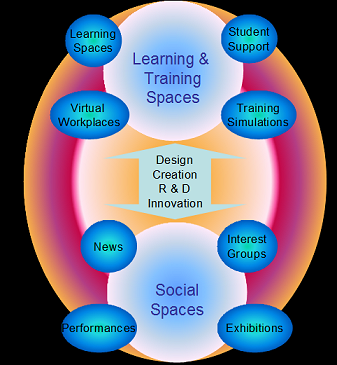
A virtual campus that connects students/teachers/mentors/community and provides opportunities for engaged learning, creative innovation and active citizenship will have

  • learning & training spaces - wide range of supportive learning environments
  • design & innovation hubs - stimulating creativity and facilitating innovative research and development
  • social & professional spaces - social commons, performances and exhibitions
The virtual campus will be designed and built by students/teachers/support staff/mentors/community to nurture and inspire the whole person - physical, mental, emotional and spiritual. Educational processes will enable holistic learning and assessment, encourage self-directed learning and focus on the principles of adult learning for the post year 10 sector.

The virtual campus will

  • organise the online environment for easy navigation
  • provide for learner, teacher and subject centric education as required
  • connect the local to the global, the physical to the virtual, the personal to the institutional
  • be playful and surprising, user created and allow user customisation
  • adapt to change and be proactive with agile development

The virtual campus will be built, serviced and accessed through a diverse range of evolving technologies meeting the needs of learners, teachers and the wider community - a kind of poly-meta-verse or 'polyverse'.


How do we integrate different services to provide users with a coherent and navigable online experience of the polyverse?


How do we build the polyverse so that it is meaningfully and usefully accessible through a range of devices? And in what ways can we blend the physical and virtual environments so that each provides windows and ports to the other?

Tuesday, June 1, 2010

Virtual 'Solutions'?


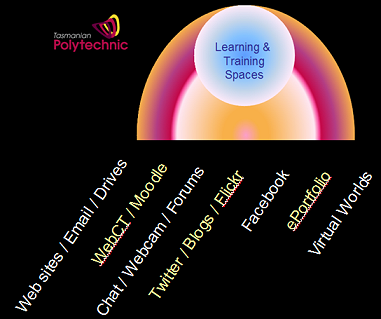
This presentation attempts to map various (mostly current) ICT services in the Polytechnic that support learning with a view to making some sense of what we might mean by a 'virtual campus' or 'virtual learning environment'.

Can we even talk about a coherent virtual campus? Should we expect to be able to integrate the diverse range of services used by learners and teachers? How do we support legacy systems (and legacy pedagogy?) still used by a significant proportion of users while also supporting clear directions in new ICT services for learning, teaching and assessment?

To what extent do we opt for new 'solutions' when it is clear that they will have a short lifetime in the continuing climate of rapid change and increasing diversity in pedagogy and ICT systems built to meet new needs?

What is the balance between hosting organisational systems with full internal support and providing organisational guidelines for users to choose external services with external support?

What will be the impact of the increasing number of learners using their own ICT devices on campus (sometimes including broadband access) and the emphasis on personalised learning and learner centred approaches - and the high proportion of learners and teachers learning and working from home?

Can organisations provide services that enable more openness - open education resources and open courseware - in a climate of security, ownership and isolation?