Showing posts with label organisation. Show all posts

Wednesday, January 4, 2017

Social Technologies Data Flow - 270 Facebook Pages

Click to open larger graphic

I've been updating the data flow or systems mapping for the Department's current social technologies.
This map shows the services and dependencies used to manage information across our official Facebook pages. The Department has around 270 official Facebook pages and post impressions range from 2-4 million per month. (See graphic at the end of this post.)

LastPass has being introduced to manage social media passwords and two-factor authentication is on for all services. Facebook admins access official pages through their own accounts (with a couple of exceptions) and Facebook Business Manager is used to manage assets, people and advertising. Google accounts and Google Authenticator are used for access/authentication to most social media services.

Hootsuite is used a little but increasingly Facebook admins prefer to visit pages individually via a desktop browser or the Facebook Pages Manager mobile app. Hootsuite is also used less than in the past for posting to multiple channels - posts are generally rewritten for different audiences and services. Hootsuite is used to monitor tags and mentions.

Facebook posts are shared between Department pages and from partner and various community pages. Longer posts are written in Blogger (or other Open Graph blogs) and then shared back to Facebook pages. Blogger is also used for the Department's Social Media Directory. Blogger is regularly backed up to XML for business continuity and PDF pages are saved for archiving.

DashThis analytics is used to complement Facebook Insights and connects to all Facebook pages via the Facebook Business Manager. We are currently investigating the use of DashThis and a few other services to display social media dashboards in the office and at events.

Digi.Me is used to archive selected official Facebook pages for reporting and storing (as PDFs) in the Department's Records Manager (HPRM).

Some challenges in this area for 2017 are:
  • To archive more Facebook pages - an increasing proportion of content is only available on Facebook pages and not just shared from other online sources such as websites.
  • To move the remaining Facebook open groups to pages - Facebook groups have no analytics or archiving.
  • To customise Facebook pages and develop some Facebook apps
As the following graphic shows Facebook use across the Department continues to rise.

Click graphic to enlarge


This post is part 1 of a series illustrating Data Flow for some Department social technologies:
  1. Social Technologies Data Flow - Facebook
  2. Social Technologies Data Flow - Instagram and Twitter
  3. Social Technologies Data Flow - Google+
  4. Social Technologies Data Flow - Video
  5. Social Technologies Data Flow - Mobile Apps
  6. Social Technologies Data Flow - Photos/Graphics

Thursday, October 6, 2016

Managing Social Technologies

Social technologies have been described as a 'third platform' comprised of social media, mobile computing, data analytics and cloud computing services. (Gartner, IDC) I'm increasingly finding this to be a useful framework.

Many organisations are moving to a more mature and strategic use of social media, mobile computing and cloud services informed by careful use and analysis of data and analytics generated by these services.

Staff and students are finding it relatively easy to create online social and learning networks for sharing, collaboration and advocacy using social technologies. However social technologies bring risks as well as agility, innovation and opportunities for creativity.

Privacy, security, ownership and control of social technologies must be understood to minimise the risks and maximise the potential benefits. Creative Commons licensing, information management and account/password management become important tools and processes.

I'm looking forward to a rewarding journey of digital transformation as we strategically navigate this space while focussing on organisational priorities to innovatively deliver key outcomes.


Saturday, February 27, 2016

Next Gen Government - Day 2 Takeaways

A small edit to the Waterforms International Water Vortex while waiting for departure at Canberra Airport. Somehow it feels appropriate for this post... See quote at the end.
These are some random thoughts I'm taking away from the second day of sessions at #NexGenGov in Canberra. These mostly relate to our current Department issues/projects rather than a comprehensive report on what was said - or who said it.

Innovate on service delivery not technology. 

Focus on customer events, circumstances, their journey...
Identify services with the highest impact. 

For many external clients (and even staff) your website 'landing page' is the Google search results page. 

The Department has Google+ pages for all schools and this has been very effective.
How might we influence/customise Google search results for the Department's main public online web and other online spaces? How could we use Google Ads and APIs?

Does current navigation make sense to the user when they drop deep within our website/CMS from an external search engine?
Need for a rethink...

The 'Internet of Your Things' offer opportunities to rethink aspects of service delivery.

Young people (including young adults) do not generally go to a government website for help.

How do we reach out to this group? Go to the platforms and places used by your intended audience.
Social media? Which platforms are being used by your intended audience? What value can you bring?

Gamification? Mobile Apps?  See Party for Your Rights.

The notion of a 'one stop shop' may become the 'one stop pop-up shop'.

Proactive Organisation - provides a product or service when it is needed rather then after it has been requested... 

Innovation SPRINT - 10 days - Discover, Define, Develop Ideas, Deliver Alpha.
Trans-departmental teams, design thinking, blue-sky thinking by 'digital natives'.
Leave space in thinking, processes and solutions/products for innovation.

Drive rapid iteration.

Overcome the fear of failure - "fail fast, fail cheaply".

3 steps to making 'good mistakes'
1. making mistakes after due care and attention
2. acknowledging mistakes
3. not repeating mistakes

Common current drivers are fear and hope - fear of disruption/disconnection/disengagement - hope for transformation.

Launch Alpha to selected audiences - even public- and then move to 'perpetual beta' or launch Beta and then move to ongoing interative development.

Gartner predicts 75% of digital organisations will 'build' not 'buy' by 2020.

See the US Digital Services Playbook - "Today, too many of our digital services projects do not work well, are delivered late, or are over budget. To increase the success rate of these projects, the U.S. Government needs a new approach. We created a playbook of 13 key “plays”...  "

Social Media

Think about archiving social media - have information management policy/procedures for social media. Think about minimum meta tags for social media.


See national Digital Continuity 2020 Policy and actions/dates.

Open Source, Open Data, Open Culture, Open Government

Open source is about much more than software. 
Tasmania has a new Open Data Policy

In what ways are we benefitting from and contributing to the staten national and globalopen agenda?
During 2016 the Department will be seeping its adoption of Creative Commons Licensing. How might this facilitate a more open culture and enable changes in service delivery?

AI, natural language and the user interface

How far away is a Siri/Cortana user interface for organisations?
"What can I help you with?"

Digital Identity and Authentication

Biometrics is delivering higher confidence authentication

One identity and login for multiple government services...

Watch MyGov, MyTax, My Health Record over the next few months and years...

Google ID, Apple ID, Facebook Connect... are already international IDs and logins.

Blocks to innovation and faster development.

A focus on fully tested perfect solutions delivered years into the future.

A focus on how to monetise assets rather than what we can do that's best for citizens/clients.

Being risk averse about privacy and security issues rather than using 'Privacy by Design' principles, getting it right, and then moving on. 

"Silicon Valley is a state of mind not a place."

Jack Welch

“If the rate of change on the outside exceeds the rate of change on the inside, the end is near.” ― Jack Welch


Wednesday, February 24, 2016

NextGen Government 2016 – My Day 1 Highlights


I’m attending the NextGen Government 2016 sessions at a time when our state Education Department is taking a step back and reviewing online services before moving forward.

This review is shaping up to be a little different from those in the past for a number of reasons:
  1. There is general acceptance that a review is necessary
  2. There is an enthusiasm for participating in the review
  3. There is some appetite to do things differently
  4. The review is a collaborative project involving IT services, marketing, communications and digital media, and an external consultant.
Within this local context my takeaways from day 1 of #nexgengov were as follows.
  • User expectations have changed – largely driven by the commercial sector.
  • Users want online services to be simple, accessible on mobiles and satisfying.
  • Use client language  - not the language of compliance.
  • 55% of users can’t find what they are looking for.
  • Users want search to work, easy navigation and click-to-chat.
  • Most users enter websites deeply via Google – not via your front page.

  • Technology disruption is now largely seen as a positive thing – this is a big change and an opportunity to create the future.
  • Move focus from procurement to servicing user needs. User-centred design.
  • Spend twice as long talking to users as other activities when preparing business case.
  • Start by telling the user story – then expand the story and join the dots. Explain the level of pain.
  • What is it really like as a user? Follow the human experience. Get on the ground and see how things work.

  • Agile. Agile. Agile. Smaller projects with rapid iterative development. Larger projects should not take such a long time to get to launch – if they do you are too late because things have moved on.
  • Public access and testing of Alpha, ongoing Beta iterative update.
  • Iterative design and iterative development is an explosive combination.
  • Culture. Culture. Culture. Culture eats strategy for breakfast. Eliminate blame culture.
  • Service to others is a key driver for staff.
  • Keep good people by doing interesting work, creating things that make a practical difference.
  • Collaborate. Collaborate. Collaborate. Collaboration is about giving up something to make someone else successful. Consider In-sourcing AND Out-sourcing.
  • Talk about values, needs, courage to take risks.
  • Openness, honesty, transparency generates trust and respect.

  • Benchmark what happens now.
  • Think through intended and unintended consequences.
  • Create once publish everywhere.
  • Citizen design – get users involved in design.
  • Gov 3.0 – customisable services
  • AI and data layers
  • If your data isn’t being openly shared you are missing out on opportunities - and soon the future of online services
  • Innovate. Innovate. Innovate.

While much of this isn't new to our organisation I'm not sure it's deeply understood.

Much of what was discussed today fits within a simple 4 quadrant model from Integral Theory from a few yeas ago. The key message is that the left hand side cannot be ignored.

Image: Dr Sue Stack


Looking forward to day 2...

Tuesday, July 27, 2010

Imagining the Polyverse


More thoughts on the virtual campus...

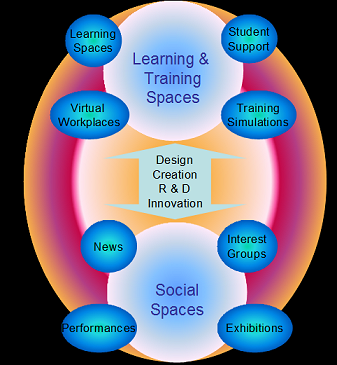
A virtual campus that connects students/teachers/mentors/community and provides opportunities for engaged learning, creative innovation and active citizenship will have

  • learning & training spaces - wide range of supportive learning environments
  • design & innovation hubs - stimulating creativity and facilitating innovative research and development
  • social & professional spaces - social commons, performances and exhibitions
The virtual campus will be designed and built by students/teachers/support staff/mentors/community to nurture and inspire the whole person - physical, mental, emotional and spiritual. Educational processes will enable holistic learning and assessment, encourage self-directed learning and focus on the principles of adult learning for the post year 10 sector.

The virtual campus will

  • organise the online environment for easy navigation
  • provide for learner, teacher and subject centric education as required
  • connect the local to the global, the physical to the virtual, the personal to the institutional
  • be playful and surprising, user created and allow user customisation
  • adapt to change and be proactive with agile development

The virtual campus will be built, serviced and accessed through a diverse range of evolving technologies meeting the needs of learners, teachers and the wider community - a kind of poly-meta-verse or 'polyverse'.


How do we integrate different services to provide users with a coherent and navigable online experience of the polyverse?


How do we build the polyverse so that it is meaningfully and usefully accessible through a range of devices? And in what ways can we blend the physical and virtual environments so that each provides windows and ports to the other?

Tuesday, June 1, 2010

Virtual 'Solutions'?


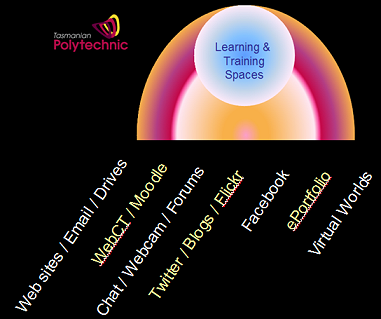
This presentation attempts to map various (mostly current) ICT services in the Polytechnic that support learning with a view to making some sense of what we might mean by a 'virtual campus' or 'virtual learning environment'.

Can we even talk about a coherent virtual campus? Should we expect to be able to integrate the diverse range of services used by learners and teachers? How do we support legacy systems (and legacy pedagogy?) still used by a significant proportion of users while also supporting clear directions in new ICT services for learning, teaching and assessment?

To what extent do we opt for new 'solutions' when it is clear that they will have a short lifetime in the continuing climate of rapid change and increasing diversity in pedagogy and ICT systems built to meet new needs?

What is the balance between hosting organisational systems with full internal support and providing organisational guidelines for users to choose external services with external support?

What will be the impact of the increasing number of learners using their own ICT devices on campus (sometimes including broadband access) and the emphasis on personalised learning and learner centred approaches - and the high proportion of learners and teachers learning and working from home?

Can organisations provide services that enable more openness - open education resources and open courseware - in a climate of security, ownership and isolation?

Saturday, May 1, 2010

Polytechnic 2.0

... will help us become more informed, responsive, innovative and learner-centred...


Unprecedented opportunity to achieve more open, accountable, responsive and efficient leadership...


Once information and learning resources are liberated as key organisational assets, possibilities — foreseeable and otherwise — are unlocked through the invention, creativity and hard work...


These statements are derived from Engage: Getting on with Government 2.0 - an Australian Government Taskforce report calling for public agencies and public servants to engage more using the tools and capabilities of the ‘collaborative web’ or Web 2.0.

This comes at a time when there are calls from within educational institutions in Tasmania to restrict and even block altogether access to Web 2 services such as Facebook.

As the Report states:

Government 2.0 requires leaders to engage with what is for many, an unfamiliar and challenging agenda. Are we up to it?

Though it involves new technology, Polytechnic 2.0 is really about a new approach... the existing culture of hierarchical control and direction must change sufficiently to encourage and reward engagement.

The Report has been released under a Creative Commons 2.5 Australia Licence allowing a new document Engage: Getting on with Polytechnic 2.0 to be derived from it - mostly by replacing the word 'Government' with 'Polytechnic' and focusing on learning and the learner.

This derived version outlines a Polytechnic 2.0 agenda in terms of three pillars:

  • Leadership, policy and governance to achieve necessary shifts in culture and practice.

  • The application of Web 2.0 collaborative tools and practices to the institution as a learning organisation.

  • Open access to leadership and management information and to open educational resources (OER).

Polytechnic 2.0 presents challenges to some well established organisational and educational practices and has the potential to change the relationship between our institution and its learning communities.

Getting back to Facebook there are many educational reasons to question the calls to restrict or block access to this and other web 2 services. According to the 2009 Horizon Report:

“Increasing globalization continues to affect the way we work,collaborate, and communicate. Information technologies are having a significant impact on how people work, play, gain information, and collaborate. Increasingly, those who use technology in ways that expand their global
connections are more likely to advance, while those who do not will find themselves on the sidelines. With the growing availability of tools to connect learners and scholars all over the world — online collaborative workspaces, social networking tools, mobiles, voice-over-IP, and more — teaching and scholarship are transcending traditional borders more and more all the time.”


For more see In Defence of Facebook.

Tuesday, June 2, 2009

Re-framing the Present

The current restructuring of Tasmanian public post year 10 education provides a good opportunity to re-conceptualise ICT services to match learning needs. A new ICT network infrastructure has been built from the ground up that supports both legacy and new systems across 16 campuses statewide.

Learning priorities have already been re-framed as the FACS Learning Model - Flexible, Applied, Connected and Supported Learning. In what ways can we re-conceptualise ICT services to enable, facilitate and support the FACS Learning Model?

We have already attempted to map a student perspective on current and planned ICT services, and to map the notion of a Virtual Campus. This post attempts yet another map - starting with learning. The learning priorities on the left are linked to the necessary ICT functionality to support them on the right:


Does it show the important ICT functionality required to enable, facilitate and support FACS Learning?

The next part of this mapping exercise emphasises the need for management processes and tools for the learner, the teacher and the institution .

'Manage MyLearning' is about each learner's need to manage all the processes, artifacts, resources, networks... as they continue their learning journey - particularly as the learner becomes more self-directed.

The teacher needs to manage their teaching processes, resources, classes, students, professional networks... Recently some have done this in a Learning Management System (LMS) - which has really been more of Teaching Management System for most.

'Manage MyInstitution' could be seen as the institutions need to manage facilities, services, staff and students... (Or it might be taking the 'My' trend too far...)

Are there other key roles that should be included here that will inform the provision of ICT services?


The next map shows some of the ICT services that might support learners, teachers and the institution. A brief description of each follows...


Folio & Pathway Management Systems: This is about much more than the provision of efolios. It is about each learner managing their own learning choices, resources, artifacts, networks... on their learning journey (pathway). The learner has control over who can view, access and share their learning resources and artifacts.

Learning Management Systems: This is the standard LMS functionality which is mostly about teacher structures and controls to support learning, teaching and assessment.

Information Management Systems: This is largely about managing and communicating institutional information and resources. Systems such as MOSS have evolved to integrate greater functionality however this requires authenticated access to a closed system.

Learning Environments: These include spaces and structures such as virtual worlds, simulations, serious games, augmented reality... Some of these can integrate resources and functionality from other management systems - eg Sloodle.

Virtual Learning Commons: This is the online component of the 'Learning Commons' that includes additional services to learning resource access such as learning support, client services and exhibition spaces.

Shared Services Management Systems: Finance, Facilities, Human Resources and much more.

Learning and Business Applications & Web Services: Office, specialist and learning tool software and web services. Includes application deployment.

Research & Project Management Systems: This has been somewhat ad-hoc in the past and could evolve to support collaborative innovation and research within and beyond the institution.

Course Management Systems: This could evolve beyond the management of in-house courses to the provision of access to Open Courseware.

What other key ICT services are required to support FACS learning?

Still missing from this mapping exercise are the range of services - including some of the management services above - that exist beyond the institution.


The full map can be seen here.

.

Saturday, March 28, 2009

Is email dead?

A colleague recently suggested that email within our organisation is not looking at all healthy and may be on its last legs. At 40 years of age email is not that old in human terms but for many staff email is well past its use-by date and often feels like this video clip with most staff receiving serveral hundred emails each month...

A full inbox is a dis-heartening sight - particularly if you spend hours emptying it one week only to discover it full the next. For some (many?) the email ritual has become one of 'quick-scan' - 'select-all' - 'delete'.

Unfortunately this process can result in missed opportunities, lost student work and low response rates.

For an organisation with over 2,000 staff across 19 campuses communication is vital but it can't always be face-to-face. And we realised some years ago that it can't be all paper-based - the large bin used to fill very quickly as staff walked away from their pigeon-holes.

So... where does that leave us? We have the telephone which is now mobile and therefore more convenient - and more intrusive. And mobiles are rapidly becoming PDAs that beep every few minutes as emails arrive - in addition to calls and SMS.

We are flooded with information but starved of what we need to know and what we would like to know.

Are there solutions? I think so... Provided we can first agree on what is best done through a particular mode of communication and how best to use the chosen mode - and then share those guidelines across the organisation.

We have many choices...

Face-to-face: Meetings don't always have to always be state-wide, or formal, or filled with information...

Email: Can be auto-directed to folders, compiled into digests or newsletters, flagged and prioritised, auto-forwarded to preferred addresses... Email should not be 'just-in-case you needed to know' information or bulk mailed when it doesn't concern the majority of users.

Portals/Websites: Can be organised to locate information just-in-time, be RSS enabled and be up-to-date.

Online spaces: Can be used for collaborative editing of documents (eg Google Documents) or more complex collaboration (Wikis or Google Groups)

Aggregators: Can be used to receive and organise and share what each person wants to know from websites, portals, newsfeeds, multimedia channels, blogs and micro-blogs, wikis... (eg Google Reader)

Podcasts/vodcasts: Can be used to broadcast or narrowcast audio and video.

Blogs/micro-blogs: Can be used to share stories, collaborate and create personal and professional networks - locally and globally.

Mobile Phones: Can be used to send reminders and information to individuals and groups - as well as get feedback.

Online meeting spaces: Can be used for communication, sharing, collaboration, simulation depending on the space chosen (eg Elluminate, FlashMeeting, Second Life...) Sessions can be recorded for playback or broadcast or narrowcast.

Paper: Can be newsletters, magazines, pamphlets, stickers, posters, cards, books...

Existing services: There are many online services, directories, channels... that are provided locally, nationally and globally for educational institutions, educators and students. (eg edna)


What else do we need to consider before deciding on guidelines for communication, collaboration, dialogue and networking across a large multi-campus organisation?

Which combination of these is likely to provide the most efficient and effective communication solution?

Is it possible to 'save' email or is it too late? :-)
.

Thursday, March 12, 2009

Still Smiling :-)

I've been asked how I feel about the new changes associated with the Polytechnic.

I realise I'm now feeling very positive. I think it's something that has crept up on me.

"Why?" I'm asked.


Good question - possibly because:
  • I recognise and appreciate the huge effort many are making to get things working in difficult circumstances.

  • I do what I can and work around what I can’t.

  • I seize opportunities in the confusion of change.

  • I manage my own time and resources as much as I can.

  • I document and dialogue my progress.

  • I see 2009 as a bridge to somewhere else.

  • I hear and tell new stories about what is and what will be.

  • I see students and staff smiling.

Does that mean everything is rosy? Not at all.

But I've relaxed into the uncertainty... let go of what used to be (well mostly)... and built new relationships.

And people are starting to smile :-)

.

Monday, March 2, 2009

Connected Learning Across a Large Organisation


2,000 staff, 18 campuses, 400 emails in one month, meetings, meetings, meetings...

The Tasmanian Polytechnic values 'Connected Learning' but how does this happen for staff across a new large multi-campus learning organisation? Fortnightly meetings have become monthly meetings, inboxes and message banks are full and time runs away...

Perhaps we need to expand our communication toolbox beyond meeting in person, mobile phones and email. There are a number of well developed services that are specifically designed to supplement traditional ways of connecting across distance and time.

The following PowerPoint looks at some of these focusing on the need to establish sustainable communities of practice that span multiple campuses and connect globally.


View full size.

Given that many staff are already beginning to feel "overwhelmed" or "out of the loop" or "without voice" the need is great...
.

Sunday, February 15, 2009

Blended Campus Tour

Here is a Google Earth Tour that you can download (unzip and open in Google Earth) that visits each campus in the Tasmanian Polytechnic for 2009 - including our vitual world locations in Second Life.

Or you can watch the video of the tour below - it includes scenes from Island Campus and Jokaydia Campus in Second Life. The Jokadia Campus has been cleared of last year's projects in readiness for 2009 - although there is a crocodile by the water... and look out for some some seals and a turtle just off shore.

If you have an avatar come and visit... here is the Jokaydia SLURL.

Second Life has many educational uses and some large international educational communities. A number of flexible learning projects will use Second Life in 2009 that were planned and tested in 2008.

Students over 18 will be using Jokaydia and the Polytechnic Island while those under 18 years of age will use Skoolaborate - a secure virtual world used by schools and colleges in the Asia-Pacific region.

Click to play - and watch the high quality version - link under video.

Friday, January 9, 2009

Signage of the Times

I thought I should record this event - new signage going up today.

No more 'Hobart College'. No more 'TAFE Tasmania'. Is it a sign of the times? Changed students, changed workplaces, changed technology, changed expectations, changed world...

Is it a sign of an appropriate response? Time will tell...

Thursday, December 18, 2008

Stages of Organisational Development?

Bill Torbet et al in Action Inquiry list 7 developmental stages for organisations – useful reading since we now have a CEO, a Board, Directors… and soon 35,000 students.

Is the fledgling Tasmanian Polytechnic about to enter Tolbert’s fourth stage: Experiments?

The stages are:

1: Conception – Dreams, visions and informal conversations about creating something new to fill a need not now adequately addressed. Critical issue: Timeliness.

2: Investments – Champions commit to creating the organisation; early relationship-building among future stakeholders. Critical issue: Authenticity and reliability of commitments.

3: Incorporation – Recognisable physical setting established; tasks and roles delineated; goals and operating staff chosen. Critical issue: Display of persistence in the face of threat.

4: Experiments – Alternative strategies are practiced, tested in operation, and reformed in rapid succession. Critical issue: Truly experimenting.

What happens next will be interesting because 4 more educational institutions join the organisation after 2009. Does this mean the organisation will remain at the Experiments stage longer than it would have otherwise? Or will it go back to the Incorporation stage as new staff join the organisation? Or will it move on to the next stages?

5: Systematic Productivity – Attention is focused only on systematic procedures for accomplishing predefined tasks; marketability or political viability measured in quantifiable terms is the overriding criterion of success.

6. Social Network – Strategic or mission-focused alliances formed among a portfolio of organisations.

7. Collaborative Inquiry – Explicit, shared reflection about mission; open interpersonal relations with disclosure, support and confrontation of apparent value differences; systematic personal and corporate performance appraisal on multiple indexes.

How quickly should the new organisation develop to the Collaborative Inquiry stage? 2010? 2011? 2012? Does the organisation need to move through these stages in strict sequence? Can stages overlap a little?


Should a large multi-site state-wide organisation like the Polytechnic operate concurrently at stages 4-7? Or even stages 1-7 with a focus that cycles through the stages depending on growth and environmental factors?