Tuesday, July 27, 2010

Imagining the Polyverse


More thoughts on the virtual campus...

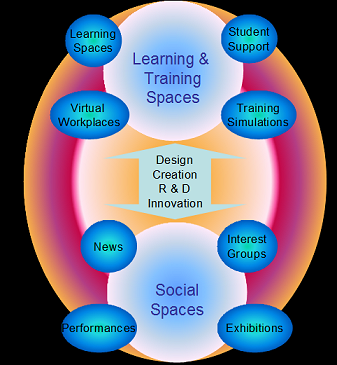
A virtual campus that connects students/teachers/mentors/community and provides opportunities for engaged learning, creative innovation and active citizenship will have

  • learning & training spaces - wide range of supportive learning environments
  • design & innovation hubs - stimulating creativity and facilitating innovative research and development
  • social & professional spaces - social commons, performances and exhibitions
The virtual campus will be designed and built by students/teachers/support staff/mentors/community to nurture and inspire the whole person - physical, mental, emotional and spiritual. Educational processes will enable holistic learning and assessment, encourage self-directed learning and focus on the principles of adult learning for the post year 10 sector.

The virtual campus will

  • organise the online environment for easy navigation
  • provide for learner, teacher and subject centric education as required
  • connect the local to the global, the physical to the virtual, the personal to the institutional
  • be playful and surprising, user created and allow user customisation
  • adapt to change and be proactive with agile development

The virtual campus will be built, serviced and accessed through a diverse range of evolving technologies meeting the needs of learners, teachers and the wider community - a kind of poly-meta-verse or 'polyverse'.
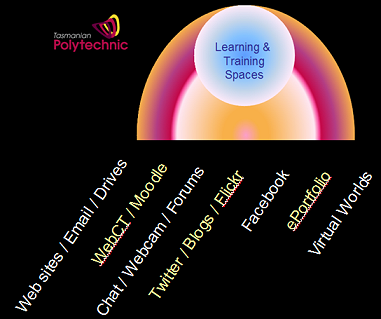


How do we integrate different services to provide users with a coherent and navigable online experience of the polyverse?


How do we build the polyverse so that it is meaningfully and usefully accessible through a range of devices? And in what ways can we blend the physical and virtual environments so that each provides windows and ports to the other?

Tuesday, June 1, 2010

Virtual 'Solutions'?


This presentation attempts to map various (mostly current) ICT services in the Polytechnic that support learning with a view to making some sense of what we might mean by a 'virtual campus' or 'virtual learning environment'.

Can we even talk about a coherent virtual campus? Should we expect to be able to integrate the diverse range of services used by learners and teachers? How do we support legacy systems (and legacy pedagogy?) still used by a significant proportion of users while also supporting clear directions in new ICT services for learning, teaching and assessment?

To what extent do we opt for new 'solutions' when it is clear that they will have a short lifetime in the continuing climate of rapid change and increasing diversity in pedagogy and ICT systems built to meet new needs?

What is the balance between hosting organisational systems with full internal support and providing organisational guidelines for users to choose external services with external support?

What will be the impact of the increasing number of learners using their own ICT devices on campus (sometimes including broadband access) and the emphasis on personalised learning and learner centred approaches - and the high proportion of learners and teachers learning and working from home?

Can organisations provide services that enable more openness - open education resources and open courseware - in a climate of security, ownership and isolation?

Friday, May 7, 2010

Avatar Make-overs and Ghosts

Avatars are going through makeovers in Tourism and Hospitality classes at the Hobart Campus. New bodies, new make-up and hair, new wardrobes... are being developed as avatars find their identity and expression. Avatars then have their photo taken to go in their blogs.


It hasn't all been easy though... Some network issues still need to be resolved that are stopping teleports - no-one can get to the mall yet to do shopping! :-) We have learned that if you become a ghost (white cloud) and lose your body you can replace your outfit from inventory to get your avatar to become 'real' again.

Saturday, May 1, 2010

Polytechnic 2.0

... will help us become more informed, responsive, innovative and learner-centred...


Unprecedented opportunity to achieve more open, accountable, responsive and efficient leadership...


Once information and learning resources are liberated as key organisational assets, possibilities — foreseeable and otherwise — are unlocked through the invention, creativity and hard work...


These statements are derived from Engage: Getting on with Government 2.0 - an Australian Government Taskforce report calling for public agencies and public servants to engage more using the tools and capabilities of the ‘collaborative web’ or Web 2.0.

This comes at a time when there are calls from within educational institutions in Tasmania to restrict and even block altogether access to Web 2 services such as Facebook.

As the Report states:

Government 2.0 requires leaders to engage with what is for many, an unfamiliar and challenging agenda. Are we up to it?

Though it involves new technology, Polytechnic 2.0 is really about a new approach... the existing culture of hierarchical control and direction must change sufficiently to encourage and reward engagement.

The Report has been released under a Creative Commons 2.5 Australia Licence allowing a new document Engage: Getting on with Polytechnic 2.0 to be derived from it - mostly by replacing the word 'Government' with 'Polytechnic' and focusing on learning and the learner.

This derived version outlines a Polytechnic 2.0 agenda in terms of three pillars:

  • Leadership, policy and governance to achieve necessary shifts in culture and practice.

  • The application of Web 2.0 collaborative tools and practices to the institution as a learning organisation.

  • Open access to leadership and management information and to open educational resources (OER).

Polytechnic 2.0 presents challenges to some well established organisational and educational practices and has the potential to change the relationship between our institution and its learning communities.

Getting back to Facebook there are many educational reasons to question the calls to restrict or block access to this and other web 2 services. According to the 2009 Horizon Report:

“Increasing globalization continues to affect the way we work,collaborate, and communicate. Information technologies are having a significant impact on how people work, play, gain information, and collaborate. Increasingly, those who use technology in ways that expand their global
connections are more likely to advance, while those who do not will find themselves on the sidelines. With the growing availability of tools to connect learners and scholars all over the world — online collaborative workspaces, social networking tools, mobiles, voice-over-IP, and more — teaching and scholarship are transcending traditional borders more and more all the time.”


For more see In Defence of Facebook.

Saturday, April 24, 2010

Playing TAG

Many staff and students are using web services for displaying, organising and sharing their work. A number of Creative Arts teachers have been looking at how work might be tagged within these services so that staff and students can search for products created

  • by Tasmanian Polytechnic students and staff
  • in the same course or qualification
  • on the same campus
  • using the same media

In addition to facilitating searching a state-wide tagging system could allow teachers to easily collate student work for quality assurance/moderation across the state.

One issue to be addressed is the fact that students and staff are currently using a range of different web services for the same function. For example photos are uploaded into Flickr, Picasa, Deviant Art... We can create a single RSS feed from multiple web services by using an RSS aggregator that creates a new combined RSS feed such as Yahoo Pipes - rather than mandate a single web service.


We would also like to showcase student work by tagging items so that they automatically appear in RSS feeds within embedded code set up for our intranet, Facebook and public website. This will be archived by creating a Flickr group (linked to a state-wide Creative Arts Flickr account) where students can display their best work. Some of this work will then be tagged for showcasing - as well as being organised into sets and galleries.

This cross-campus tagging can also be applied to web services for video, audio and other media - any services that provide an RSS feed from tag searches.

Some of the thinking behind the use of tagging is presented in the following slides created for Creative Arts staff considering using Flickr for the first time to encourage student comment and reflection. They would also like to use it to facilitate some mentoring and critique from the arts community outside the organisation.


Thursday, April 1, 2010

Learning to Walk...


Above you can see teacher Hilary Reader making some final head adjustments before taking her avatar to the hairdresser. On the right on the big screen one of her Tourism students flies over Jokaydia in Reaction Grid while on the desktop a Hospitality student walks her avatar through a forest on the Island Campus of the Tasmanian Polytechnic in Second Life.


Over the last week 4 classes (60 students) have been introduced to virtual worlds - well virtually introduced... we had a few technical issues but we are almost there.


The students are from a range of courses in Tourism, Hospitality and Events Management at the Hobart and Drysdale South Campuses. They will explore and work in both Second Life and Reaction Grid - and perhaps some other virtual worlds.


Evidence for assessment including photo's, movie clips and reflective journals will be displayed in ePortfolios that all the students have now set up in the Polytechnic's Mahara. The students have all joined a 'Virtual World' group in Mahara that contains links to help and tasks, and most have added classmates as 'friends', customised their profiles and made comments on each others 'walls'.


Avatars have been registered and some students have begun to learn how to walk, talk, sit down and fly. After Easter they will learn to eat, dance, teleport and take photo's.


Some technical issues with graphics cards and ports meant that some students used Open Sim on USB memory sticks to practice customising their avatar's appearance. To make the USB world more interesting some of our buildings from the Island Campus in Second Life were copied across to the USB world using the Meerkat Viewer.


More classes will be joining these students after the Easter break.

And in news just in... We've heard that funding has been approved for the project: Virtually Here by the Australian Flexible Learning Framework. Project descrition:

Virtually Here

"To improve opportunities for collaborative interaction and communication for students who are geographically isolated, using the virtual world of Second Life (for adult learners) and Reaction Grid (for students who are under 18 years of age) as the primary learning platforms."

Thursday, March 11, 2010

Web 2.0 Exploration


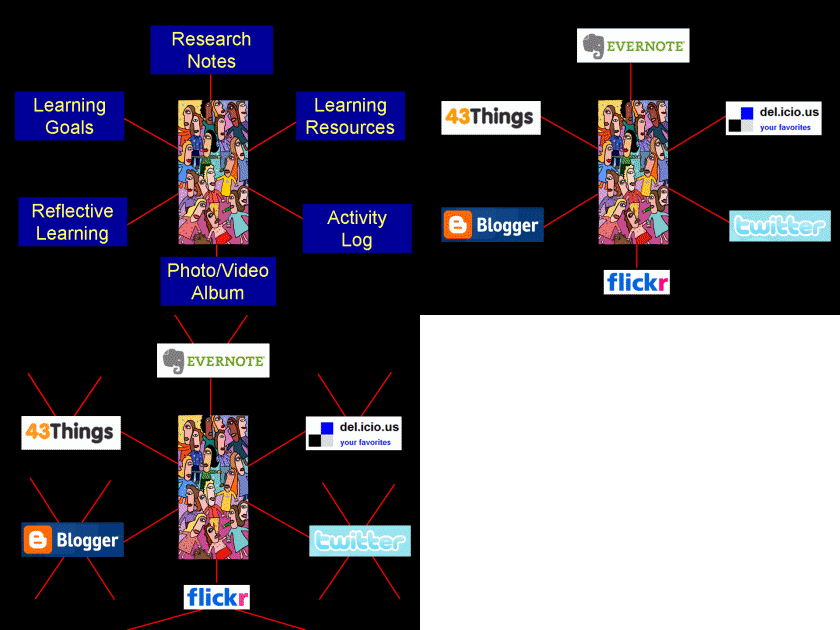
40% of Polytechnic teachers are currently exploring web 2.0 or collaborative web services for learning. Many are using online blogs, photo or video albums for reflective learning or folios for assessment evidence or showcasing work.

The graphic above shows some examples of other web 2.0 services being used by teachers for learning, teaching and assessment. The red lines are indicative of the networks of 'friends' that each service may also bring to the 'classroom' giving an outside audience and increasing the potential for collaboration.

The Flexible Learning Team is now making some recommendations about which particular web service to use for specific learning tasks or desired learning outcomes. This will not only guide those who may be looking for a service to meet their needs but also create a critical mass of users within the organisation that can help each other.