Today we launched a 3 month project to develop a 2012-14 eLearning Strategy for the Polytechnic. The Strategy will grow out of a wiki as a living plan for eLearning across the state.
The wiki will be open for edit and stakeholders will be able to watch the eLearning Strategy emerge as they participate in a process of co-construction.
Through this openness we hope to engage more people in an transparent process that acknowledges the complexity of the task, multiple perspectives with their underpinning values and assumptions, and the challenge of strategically planning for on-going change and financial sustainability.
We will use a perspective model developed by Dr Sue Stack for a recent Faculty of Education NBN in Education Project at the University of Tasmania. This project examined the challenges of creating connectivity for Tasmanian education through an openly consultative process involving ICT leaders across different educational sectors.
Tomorrow students and the wider community will be invited through Facebook and Twitter to contribute to the wiki pages and discussion. With analytics running on various online resources we hope to be able to build on the most effective communication strategies during the project.
Tuesday, July 5, 2011
eLearning Strategy Opening
Wednesday, June 8, 2011
eQuestioning eLearning
Some point out that eLearning is really about learning - which already has e integrated into learning - as it should.
Is e-learning still conceptually the same as e-mail - electronic-mail from the 70s? What is electronic learning?
Should we be developing a 'Digital Technologies and Services Learning Strategy'? Apart from being a mouthful does the term invite us to envision learning for the 2nd decade of the 21st Century?
Derek Wenmoth in eLearnings: Implementing a National Strategy for ICT in Education, 1998-2010 describes recent moves conceptually from connected eLearning to networked Virtual Learning and the development of the 'networked school'.
The Polytechnic also has a focus on a virtual campus and blended online and face-to-face learning.
Would a 'Networked Learning Strategy' be more appropriate than an 'eLearning Strategy'?
Conceptually networked learning appears to have broader connotations:
- face-to-face and online networking
- personal and professional learning networks
- learning communities and communities of practice
- national broadband networking of homes, workplaces, community centres with campuses
- connecting the physical, the virtual and the mobile
- networked cloud computing
Or is that a bridge too far? Everyone has just got used to eLearning :-)
Sunday, May 8, 2011
Being Present During Transformational Change
Following my post 'Designing for the 4th Bottom Line' my wife put together a graphic that puts Presence in the centre - and I like it very much. She also used the term 'prosperity' rather than 'profit' and I think that is richer and more inclusive and resonates with Bhutan's 'gross national happiness index'.
The 4th bottom line has been called 'personal', 'perspective', 'spirituality', 'culture' and 'sustainability' but I prefer 'presence' following Peter Senge et al in the book Presence: Human Purpose and the Field of the Future.
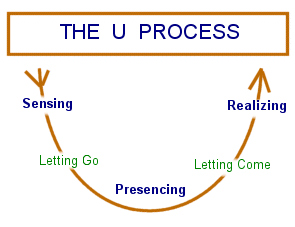
The authors describe the 'U Process' for organisational or systemic change:
Sensing – knowing the whole system as it is
Letting go - of historical processes and perspectives
Presencing - taking time to retreat and reflect
Letting come - allowing new processes to become realised
In re-reading parts of the book today I found the notions of 'presencing', 'letting come' and 'realizing' particularly relevant as we envisage a virtual campus and new online spaces.
From Presence:
"Moving up the U involves bringing something new into reality... but this action comes from a source that's deeper than the rational mind... the magic comes from the capacity to sense something new and act instananeously in accordance with what that felt knowledge dictates."
"Operating from this larger intention brings into play forces one could never tap from just trying to impose our will on a situation."
"At it's essence the U theory poses a question: 'What does it mean to act in the world and not on the world?' "
In facilitating participative change I would also ask in what ways can we co-create what is best for the world rather than (or in addition to) what is best in the world?
The 4th bottom line has been called 'personal', 'perspective', 'spirituality', 'culture' and 'sustainability' but I prefer 'presence' following Peter Senge et al in the book Presence: Human Purpose and the Field of the Future.
The authors describe the 'U Process' for organisational or systemic change:
Sensing – knowing the whole system as it is
Letting go - of historical processes and perspectives
Presencing - taking time to retreat and reflect
Letting come - allowing new processes to become realised
In re-reading parts of the book today I found the notions of 'presencing', 'letting come' and 'realizing' particularly relevant as we envisage a virtual campus and new online spaces.From Presence:
"Moving up the U involves bringing something new into reality... but this action comes from a source that's deeper than the rational mind... the magic comes from the capacity to sense something new and act instananeously in accordance with what that felt knowledge dictates."
"Operating from this larger intention brings into play forces one could never tap from just trying to impose our will on a situation."
"At it's essence the U theory poses a question: 'What does it mean to act in the world and not on the world?' "
In facilitating participative change I would also ask in what ways can we co-create what is best for the world rather than (or in addition to) what is best in the world?
Labels:
futures,
indicators,
transformation,
virtual.campus
Thursday, April 28, 2011
State-wide iPad Management
Efficient and effective state-wide management of iPads for Health & Wellbeing staff and students has proven to be easier than first thought - with help from a colleague. By using a Gmail account to create an Apple ID it has been possible to provide the required iPad functionality without making management too onerous.
Multiple iPads are set up and updated using the same iTunes account in different regions across the state.
MobileMe provides a service to locate each iPad on Google Maps and to send any iPad a pop-up message, make sound to help in locating it and even lock it from further use if necessary.
DropBox and the DropBox iPad application are used to transfer and share files between the iPads, desktop PCs and with any user on the web with a DropBox account.
Google Reader is used as an RSS aggregator to manage blogs and specialised news feeds which can then be displayed through the Flipboard app on the iPad - along with Twitter lists.
Custom backgrounds are set up on each iPad to assist with identification.
See the iPad Management PowerPoint for more detail.
Multiple iPads are set up and updated using the same iTunes account in different regions across the state.
MobileMe provides a service to locate each iPad on Google Maps and to send any iPad a pop-up message, make sound to help in locating it and even lock it from further use if necessary.
DropBox and the DropBox iPad application are used to transfer and share files between the iPads, desktop PCs and with any user on the web with a DropBox account.
Google Reader is used as an RSS aggregator to manage blogs and specialised news feeds which can then be displayed through the Flipboard app on the iPad - along with Twitter lists.
Custom backgrounds are set up on each iPad to assist with identification.
See the iPad Management PowerPoint for more detail.
Tuesday, April 26, 2011
Designing for the 4th Bottom Line
Designing a virtual meta-campus for change may be more like gardening than building. Applying a Meta-Design Framework will probably be an organic process where the meta-campus is nurtured to grow and evolve - sometimes in surprising ways. It may even be like curating large and diverse gardens with local ecosystems and a range of complex challenges related to inputs/outputs, people and the planet.
Perhaps we need to think of the virtual meta-campus as both an organisation and an organism - and even a self-organising system. Many organisations now report against multiple bottom lines - even to a 4th bottom line. How would consideration of four bottom lines influence the meta-design of the virtual meta-campus?
1st Bottom Line: Profit
Learning outcomes, retention rates, financial sustainability...
2nd Bottom Line: People
Equity, social justice, social capital...
3rd Bottom Line: Planet
Ecological sustainability, ecological footprints...
4th Bottom Line: Presence
Personal meaning, fulfilment, being and becoming, spirituality...
How would the meta-campus meet goals, model processes, enable participation and empower users in each of these areas of accountability?
How would each bottom line shape the following attributes of the virtual meta-campus?
Information, places, spaces, processes, services, worlds, story telling, dialogue, challenge and exploration, growth and transformation, experience and reflection, roles and goals, creativity and innovation, imagination and play, partnerships and collaborations, sharing and generosity, celebration and inspiration, courses and special interest groups, connecting and networking (PLNs), help and guidance, citizenship and advocacy, local and global, open courseware and OERs, interdisciplinary and transdisciplinary approaches...
Monday, April 25, 2011
Meta-Design of a Virtual Meta-Campus
"In a world that is not predictable, improvisation, evolution, and innovation are more than a luxury: they are a necessity. The challenge of design is not a matter of getting rid of the emergent, but rather of including it and making it an opportunity for more creative and more adequate solutions to problems." (Fischer & Giaccardi, 2006)
Designing a virtual meta-campus is a complex systems wicked problem. There isn't one solution, technologies are changing, goals are shifting, unexpected possibilites emerge and the results are unpredictable. Traditional elearning design principles may not be the most productive in this type of dynamic challenge where 'perpetual-beta' is often the norm.
Fischer & Giaccardi present a conceptual framework for 'Meta-Design' that addresses design-for-change issues and recommend 'co-adaptive' processes that can be used to develop an agile system that evolves with its designers, developers and users.
Meta-design uses social and technical infrastructure that isn't designed completely before use, is flexible and evolves in the hands of users. At the same time users adapt to system functionality and a dialogue is developed in which the user helps design the design process.
The Meta-Design Framework has several elements:
- Design for change - user participation and empowerment
- Underdesign - create flexible environments rather than solutions
- Open systems approaches - that can be modified by users and evolve during use
- Seeding - working components that can be evolved through small contributions of large numbers of people
- Unselfconcsious design culture - slow adaption and error reduction
According to Fischer & Giaccardi Meta-Design approaches need to consider:
- Interactive Art - focus on collaboration and co-creation, often exploring feelings and emotions
- Collaborative synchnocity - allowing 'power' users to interact with the community, the project and ongoing collaborative processes
- Social creativity - building a shared user understanding and user voice leading to new insights, new ideas, new artifacts
- Balancing standardisation and improvisation - avoiding the disfunctional extremes of both
- Consumers and Designers - Some users (not all, not at all times, not in all contexts) want to be designers: "engage the talent pool"
- Ease-of-Use Revisited - Over-specialised easy-to-use systems may not be that interesting. Users will learn to operate a system if it has personal value - and is empowering, engaging and fun.
- Motivation and Rewards - Users will persist in tasks if the 'design culture' includes simple motivational activities - particularly those that build 'social capital'.
The Meta-Design Framework includes three integrated 'Design Spaces':
- Designing Design - higher-order design that allows for change and even transformation
- Designing Together - facilitating participatory design processes
- Designing the 'In-Between' - supporting and creating social networks and their interaction with technology and systems. Relational, reciprocal and recursive interactions that trigger co-creation.
Participatory design requires new paradigms and cultures. Can we create the design spaces and facilitate the deign processes needed to build the virtual campus? Indeed how can we embed these in an evolving virtual campus?
Saturday, April 23, 2011
Virtual Campus Framework
Regional meetings have recently been held to progress the Virtual Campus Project discussed in previous posts on this blog: Imagining the Polyverse, Building a Sustainable Polyverse.
While the Polytechnic has an 'official' LMS and public website there are a plethora of other online services, resources and environments independently developed by innovative individuals and teams to meet the needs of learners. So much so that it's valid to ask if we already have a 'virtual campus' in the sense of a rich and diverse online capacity that provides required functionality for remote and local students to engage in learning and training.
What is clearly absent however is any sense from a student perspective of a coherent and connected Polytechnic online service/space. Most online students are isolated from each other and from other classes, campuses and learning communities. There is little sense of a 'virtual campus' and navigation between online spaces is almost non-existent.
Rather than launch into planning and building a 'virtual campus' after hearing (for the first time for many present) about the numerous online services beyond the official LMS all meetings recommended:
- Defining the notion of a 'virtual campus' for discussion
- Listing some guiding principles that might form a conceptual framework within which further online innovation might take place
- Develop a model or models to provide systemic views of virtual campus infrastructure, navigation, standards, data flow...
Several people expressed the desire to ensure that any processes put in place to build a coherent and connected virtual campus continued to support innovation within and outside the project, as well as being agile enough to cope with changing technologies, diverse pedagogies and genuine student choices in learning.
At some meetings there was discussion about the use of designs/technologies to connect existing online spaces such as
- tagging and meta-tagging
- visual ecologies such as 360 panorama
- immersive 3D environments
- gamification and levels
How does one navigate a complex and rapidly growing virtual campus where anything is possible?
What should we call the virtual campus? The staff intranet is called Phoenix. Any suggestions for the name of an inspiring online meta-campus that blends the physical, the virtual and the possible?
Subscribe to:
Posts (Atom)