Showing posts with label indicators. Show all posts

Sunday, May 8, 2011

Being Present During Transformational Change

Following my post 'Designing for the 4th Bottom Line' my wife put together a graphic that puts Presence in the centre - and I like it very much. She also used the term 'prosperity' rather than 'profit' and I think that is richer and more inclusive and resonates with Bhutan's 'gross national happiness index'.

4th Bottom Line by Dr Sue Stack

The 4th bottom line has been called 'personal', 'perspective', 'spirituality', 'culture' and 'sustainability' but I prefer 'presence' following Peter Senge et al in the book Presence: Human Purpose and the Field of the Future.

The authors describe the 'U Process' for organisational or systemic change:

Sensing – knowing the whole system as it is
Letting go - of historical processes and perspectives
Presencing - taking time to retreat and reflect
Letting come - allowing new processes to become realised
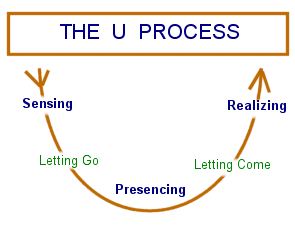
In re-reading parts of the book today I found the notions of 'presencing', 'letting come' and 'realizing' particularly relevant as we envisage a virtual campus and new online spaces.

From Presence:

"Moving up the U involves bringing something new into reality... but this action comes from a source that's deeper than the rational mind... the magic comes from the capacity to sense something new and act instananeously in accordance with what that felt knowledge dictates."

"Operating from this larger intention brings into play forces one could never tap from just trying to impose our will on a situation."

"At it's essence the U theory poses a question: 'What does it mean to act in the world and not on the world?' "

In facilitating participative change I would also ask in what ways can we co-create what is best for the world rather than (or in addition to) what is best in the world?

Tuesday, April 26, 2011

Designing for the 4th Bottom Line


Designing a virtual meta-campus for change may be more like gardening than building. Applying a Meta-Design Framework will probably be an organic process where the meta-campus is nurtured to grow and evolve - sometimes in surprising ways. It may even be like curating large and diverse gardens with local ecosystems and a range of complex challenges related to inputs/outputs, people and the planet.

Perhaps we need to think of the virtual meta-campus as both an organisation and an organism - and even a self-organising system. Many organisations now report against multiple bottom lines - even to a 4th bottom line. How would consideration of four bottom lines influence the meta-design of the virtual meta-campus?

1st Bottom Line: Profit
Learning outcomes, retention rates, financial sustainability...

2nd Bottom Line: People
Equity, social justice, social capital...

3rd Bottom Line: Planet
Ecological sustainability, ecological footprints...

4th Bottom Line: Presence
Personal meaning, fulfilment, being and becoming, spirituality...

How would the meta-campus meet goals, model processes, enable participation and empower users in each of these areas of accountability?

How would each bottom line shape the following attributes of the virtual meta-campus?

Information, places, spaces, processes, services, worlds, story telling, dialogue, challenge and exploration, growth and transformation, experience and reflection, roles and goals, creativity and innovation, imagination and play, partnerships and collaborations, sharing and generosity, celebration and inspiration, courses and special interest groups, connecting and networking (PLNs), help and guidance, citizenship and advocacy, local and global, open courseware and OERs, interdisciplinary and transdisciplinary approaches...

Sunday, May 24, 2009

Measuring Flexible Learning - Breadth and Depth

We are thinking about how to establish benchmarks and measure progress in flexible learning across the Tas Polytechnic - 16 campuses and 1500 teaching staff. But before we can decide on some key performance indicators we need a common and agreed definition of flexible learning.

Flexible learning is often defined as providing learners with choices about where, when, how - and sometimes what - learning occurs. The goal is personalised learning that meets the needs of each and every student - both on and off campus.

The degree of flexible learning that an educational organisation can provide will depend on a range of factors including:

  • learning, teaching and assessment principles and practice
  • facilities and support structures
  • course and learning designs
  • learner engagement and responsibility
  • accountability and quality assurance

Strategies which have been used to increase the level of flexibility in learning include:

  • eLearning and Flexible Delivery
  • Flexible/Open Learning Options
  • Curriculum/Training Package Frameworks
  • Learning Environment/Space Design
  • Professional Learning, Sharing and Collaboration
  • Facilities and Infrastructure for Access and Equity
One objective of the Tasmanian Polytechnic is to "establish flexible learning as part of every teacher's repertoire" - broadening the availability of flexible learning options beyond 'champions', early adopters and specialist areas and deepening the degree of flexible learning beyond the provision of simple content and delivery alternatives.

Flexible learning is not new to the organisation. Many - if not most - teachers already provide some form of choice for learners and there are numerous examples of individuals, teams and learning areas that provide very effective and innovative options for personalised learning, learning spaces and learner support. We need to learn from these and 'mainstream' them.

There are many examples of flexible 'elearning' including some that not only offer content, delivery and communication choices but go deeper to collaboration, reflective assessment and blended learning.

The Australian Flexible Learning Framework suggests a range of elearning indicators that we could adapt for measuring flexible learning. A number of these could use data that is already being collected to establish some early benchmarking.

Does anyone know of any other measures or KPI lists for flexible learning in that go beyond superficial adoption of ICTs?
.