Sunday, June 24, 2012

Managing Change

I have a new job - a 6 month Project Management position implementing a new Internet and Intranet for the Tasmanian Department of Education. My previous role in state-wide strategic planning and implementation of eLearning came to an end as new priorities were set due to budget constraints.

Current DoE Website


The Internet-Intranet project has already been running for 9 months and has implementation deadlines of 31st July for the Internet and mid-December 2012 for the Intranet.

Why are we building a new Internet-Intranet? Two key issues are:
  • Difficulty locating information and services through searching or browsing
  • Lack of information currency and expectations for faster online publishing
What are the features of the new Internet?
  • Navigation, content and access to services will reflect the needs of our principal user groups of parents and carers, students, community partnerships, government and business, and the general public.
  • Content management, access rights and web services will be delivered on SharePoint 2010 rather than the current MySource Matrix.
What are the current challenges?
  • 100s of documents and web pages that no longer meet the needs of intended audiences or organisational priorities - and too many dead links. The current website has over 1,200 web pages and several hundred documents.
  • A web structure and publishing culture that strongly mirrors the products and services of organisational units rather than being driven by end-user needs.
  • National web accessibility guidelines, the rapid increase in mobile device access and the rise of social media.
Having been an end-user of the DoE website for over 15 years I'm looking forward to working with various teams to help shape its next incarnation. As an admin user of SharePoint 2003 and 2007 I'm also interested to see what SharePoint 2010 has to offer.

Saturday, March 3, 2012

The LMS in a 2012 DLE


Where does the LMS sit in 2012? The need to consider post WebCT options, cuts to budget and IT support, student and teacher preferences, changes in learning and 'delivery', new national VET eLearning agenda... has led us to explore a more organic and distributed learning environment.

Yesterday Joyce Seitzinger in her post The LMS as a mixing panel for social learning touched on other drivers that have also contributed to the development of a new project that will provide an integrated range of online learning services for staff and students in 2012.

The following 6 min video describes the stage 1 implementation of this project that has just begun.


Will this model give us the agility we need to continuously co-create the online learning services that are required to 2015 and beyond?
Will this model be effective and sustainable?

Wednesday, September 14, 2011

Are We There Yet?

Can we begin to define our approaches to 21st century learning from experience? Developing an eLearning Strategy that takes us to the middle of the second decade has involved looking back to see what go us to where we are now.

In the late 90s and early into this new century we valued flexibility, sharing, collaboration, problem solving, future proofing... Looking at these now they appear to be largely reactive. They were our response to rapid change and the hazy emergence of new perspectives and paradigms; new ways of thinking, doing and being.

Now that we have a little experience of this century can we see trends more clearly and be more discerning and confident about how we respond?

I wonder if we are starting to make more sense of our current times and are more comfortable living with change. We are beginning to explore new possibilities and map new journeys. We are beginning to be more proactive and purposeful. We understand a little more about how to not only live more comfortably but to prosper during rapid transformational change.

Being flexible while we adapt to changing environments is shifting to being more agile - taking purposeful steps on journeys through change.

Future proofing solutions against change has become future building as we leaverage the opportunities provided by constant change.

Solving problems of increasing complexity has led to more systemic thinking and problem prevention.

Questioning one-size-fits-all solutions has led us to question our perspectives, underlying assumptions and world views.

Is planning for learning in the second decade of this century about a shift to include more pro-active strategies such as those on the right hand side of the list below?

Flexibility --> Agility
Future Proofing --> Future Building
Problem Solving --> Problem Prevention
Collaboration --> Co-creation
Social Justice --> Social Inclusion
Questioning Solutions --> Questioning Assumptions
World's Best --> Best for the World

In what other ways have we become more proactive and purposeful?
How else has our thinking, doing and being changed?
How do our new understandings impact on the development of elearning?

Or is it too early to tell?

Sunday, August 21, 2011

ITs - Back to Basics


We've been listening for several weeks to views about online learning while traveling around the State to discuss the development of a Polytechnic eLearning Strategy for 2012-2014.

For some this is just more of the same e-learning rhetoric they've heard for the last decade or more. For others it's about new opportunities or solving existing problems. Some have stories to share of very successful elearning.

As these and other views were shared at a recent State eLearning Strategy meeting what emerged was a little surprising. Out of the extraordinary diversity of experience and passionately held views about urgent needs and potential solutions came the recognition that it was time to ask much deeper questions about the use of information technologies for learning.
  • What is good learning, teaching and assessment? (online, face-to-face, blended)
  • Where and when can learning take place?
  • Who can support the learner and the teacher?
It became apparent that it's also time to question some long held assumptions about eLearning such as
  • There is one best solution (one LMS, one ePortfolio, one eLearning design method...)
  • In-house IT Services provides for and supports all e-learning needs
  • Most students don't have off-campus access to IT
  • eLearning requires content development
  • Classes need access to a computer lab
  • Students can't learn without a teacher
  • Online learning is a poor alternative to face-to-face learning
Other agenda provide further reasons to question assumptions about how we provide education and training such as
  • High ownership of mobile devices and the new 4G network due before the end of 2011
  • The availability of a wide range of cloud-based managed IT services
  • The current poor financial situation and its impact on resources and support services
  • High-speed broadband through the National Broadband Network currently being rolled out across the state
  • The desire for more flexible and agile learning
Can we get back to the basics of what education and training in the Polytechnic is about and think differently about how we might use all available resources including information technologies to give students access to quality learning?

Tuesday, July 5, 2011

eLearning Strategy Opening

Today we launched a 3 month project to develop a 2012-14 eLearning Strategy for the Polytechnic. The Strategy will grow out of a wiki as a living plan for eLearning across the state.

The wiki will be open for edit and stakeholders will be able to watch the eLearning Strategy emerge as they participate in a process of co-construction.

Through this openness we hope to engage more people in an transparent process that acknowledges the complexity of the task, multiple perspectives with their underpinning values and assumptions, and the challenge of strategically planning for on-going change and financial sustainability.

We will use a perspective model developed by Dr Sue Stack for a recent Faculty of Education NBN in Education Project at the University of Tasmania. This project examined the challenges of creating connectivity for Tasmanian education through an openly consultative process involving ICT leaders across different educational sectors.

Tomorrow students and the wider community will be invited through Facebook and Twitter to contribute to the wiki pages and discussion. With analytics running on various online resources we hope to be able to build on the most effective communication strategies during the project.

Wednesday, June 8, 2011

eQuestioning eLearning

The Polytechnic is embarking on the development of an 'eLearning Strategy' - but what do we mean by 'e' Learning?

Some point out that eLearning is really about learning - which already has e integrated into learning - as it should.

Is e-learning still conceptually the same as e-mail - electronic-mail from the 70s? What is electronic learning?

Should we be developing a 'Digital Technologies and Services Learning Strategy'? Apart from being a mouthful does the term invite us to envision learning for the 2nd decade of the 21st Century?

Derek Wenmoth in eLearnings: Implementing a National Strategy for ICT in Education, 1998-2010 describes recent moves conceptually from connected eLearning to networked Virtual Learning and the development of the 'networked school'.

The Polytechnic also has a focus on a virtual campus and blended online and face-to-face learning.

Would a 'Networked Learning Strategy' be more appropriate than an 'eLearning Strategy'?
Conceptually networked learning appears to have broader connotations:
  • face-to-face and online networking
  • personal and professional learning networks
  • learning communities and communities of practice
  • national broadband networking of homes, workplaces, community centres with campuses
  • connecting the physical, the virtual and the mobile
  • networked cloud computing
It could also refer to how such a strategy should be developed - collaboratively - even co-constructively. Perhaps it could even be massively openly collaborative (following Jane McGonigal's discussion in Reality is Broken).

Or is that a bridge too far? Everyone has just got used to eLearning :-)

Sunday, May 8, 2011

Being Present During Transformational Change

Following my post 'Designing for the 4th Bottom Line' my wife put together a graphic that puts Presence in the centre - and I like it very much. She also used the term 'prosperity' rather than 'profit' and I think that is richer and more inclusive and resonates with Bhutan's 'gross national happiness index'.

4th Bottom Line by Dr Sue Stack

The 4th bottom line has been called 'personal', 'perspective', 'spirituality', 'culture' and 'sustainability' but I prefer 'presence' following Peter Senge et al in the book Presence: Human Purpose and the Field of the Future.

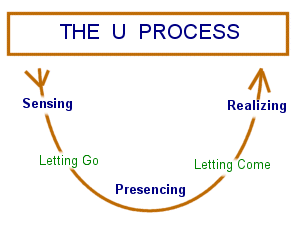
The authors describe the 'U Process' for organisational or systemic change:

Sensing – knowing the whole system as it is
Letting go - of historical processes and perspectives
Presencing - taking time to retreat and reflect
Letting come - allowing new processes to become realised

In re-reading parts of the book today I found the notions of 'presencing', 'letting come' and 'realizing' particularly relevant as we envisage a virtual campus and new online spaces.

From Presence:

"Moving up the U involves bringing something new into reality... but this action comes from a source that's deeper than the rational mind... the magic comes from the capacity to sense something new and act instananeously in accordance with what that felt knowledge dictates."

"Operating from this larger intention brings into play forces one could never tap from just trying to impose our will on a situation."

"At it's essence the U theory poses a question: 'What does it mean to act in the world and not on the world?' "

In facilitating participative change I would also ask in what ways can we co-create what is best for the world rather than (or in addition to) what is best in the world?